Hi, I’m Bo, the local voice behind Seoul With Me. When visitors picture “Korean etiquette,” they usually imagine a book of formal rules waiting to catch them out — the bow angle, the honorifics, the ancient customs. In everyday Seoul, almost none of that is what actually matters. What matters is a handful of small daily habits: where you stand, how you call a waiter, whether you reach for your wallet expecting to tip. Get those right and the city opens up a little — staff relax, strangers soften, and you stop feeling like you’re guessing.
So let me say the reassuring part first, because it’s the truest part: Seoul is genuinely forgiving to foreigners. Nobody expects you to know the honorifics or to bow correctly. People here can tell in a second that you’re a visitor, and the default reaction is patience, not judgment. This guide isn’t a list of ways to offend people. It’s the set of small things I find myself explaining over and over — the stuff that makes the difference between feeling like you’re bracing for a test and feeling at ease.
The short version, before the details
If you only remember five things, remember these:
- Don’t tip. Anywhere. The price on the menu is the price.
- Keep it quiet on the subway, and leave the pink priority seats empty.
- Skip Google Maps for directions — download Naver Map or KakaoMap.
- Call the waiter over out loud. Waving and saying “yeogiyo” is correct, not rude.
- Carry a little cash for markets and street food, even though almost everything else takes cards.
Everything below is just those instincts, filled in with the reasons and the edge cases.
On the subway and the street
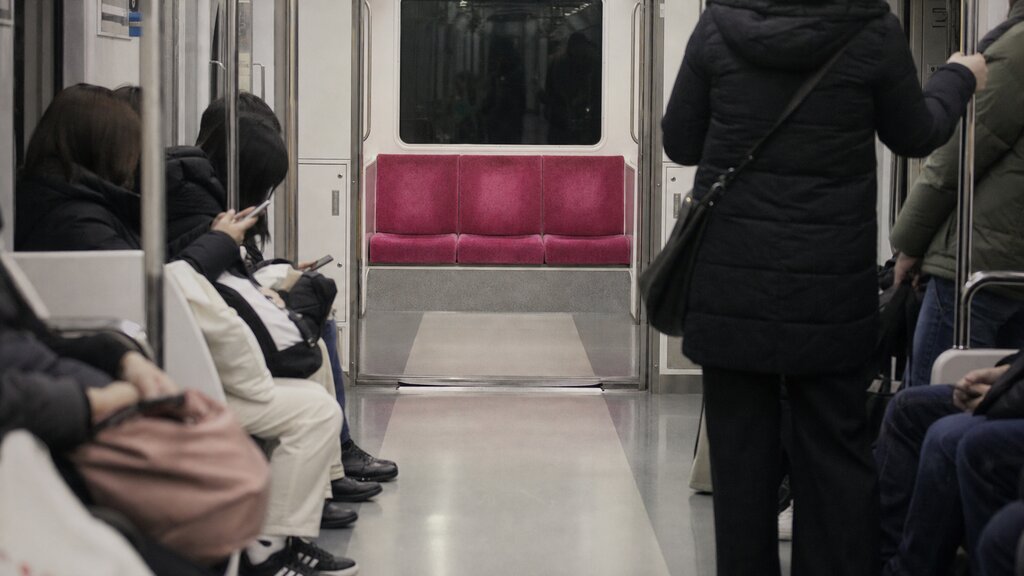
The single most common thing visitors misread is subway volume. Seoul trains are quiet — not silent, but noticeably hushed compared to a New York or London carriage. People keep phone calls short or skip them, keep videos on headphones, and generally don’t hold loud conversations across a car. I drive almost everywhere in Seoul, so I’m not on the subway daily and I won’t pretend otherwise. But this is the question visitors ask me most, so here’s what I tell every one of them: match the volume of the car around you, put your phone on silent, and you’ll never think about it again.
The other subway habit that surprises people is the empty seats. You’ll see clearly marked priority seats — usually a different color, at the ends of each car — left open even when the train is packed and people are standing over them. These are for elderly, pregnant, and disabled passengers, and Koreans genuinely keep them free rather than gamble on having to give one up. There are also pink-marked seats reserved specifically for pregnant riders. Just leave them. Stand in the middle of the car instead of clustering by the doors, step off to let people out at busy stops, and tap your card both when you enter and when you exit — Seoul’s fares are distance-based, so tapping out actually matters. I walked through the whole card question in the Seoul transport card guide, since that’s the other thing every first-timer asks me about.
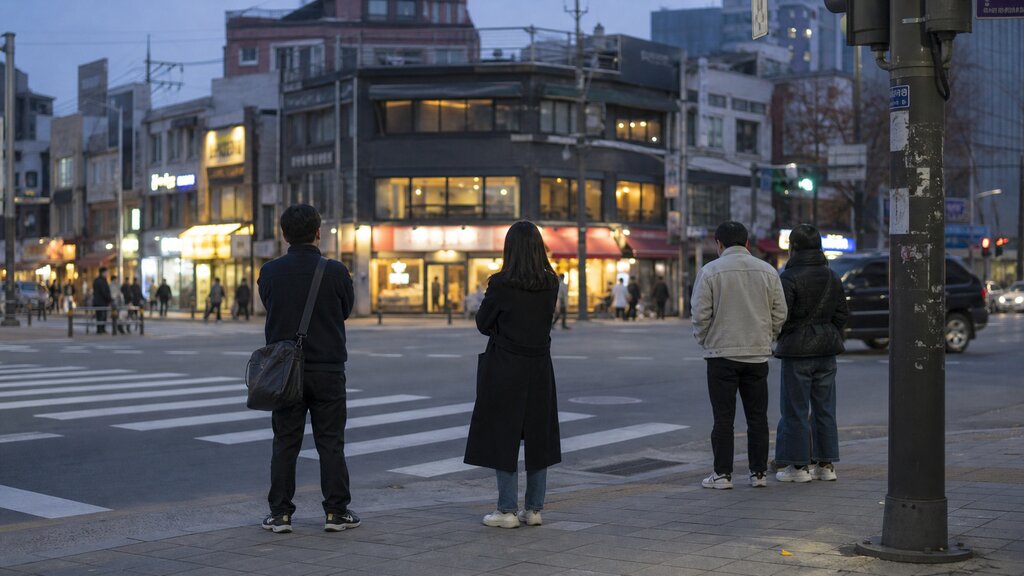
Up on the street, a couple of small tells mark you as either relaxed or lost. Seoulites wait for the walk signal — jaywalking is genuinely uncommon here, even on an empty side street at midnight, and crossing against the light draws quiet looks. On escalators, the informal habit is to stand on the right and leave the left open for people walking up. And you’ll notice there are almost no public trash bins on the sidewalk, which brings me to a mistake I watch visitors make constantly: they finish a coffee and start hunting for a bin that isn’t there. People here just carry their trash until they reach a convenience store or their accommodation. Recycling and food-waste separation are taken seriously, so when you do find bins, they’ll be sorted — take the extra two seconds to sort with them.
The maps problem nobody warns you about
Here’s the one that catches almost everyone off guard: Google Maps does not do driving or walking directions properly in Korea. This isn’t a bug or a bad signal. For long-standing national security reasons, Korea restricts the export of detailed mapping data, so Google can’t route you turn-by-turn the way it does elsewhere. You’ll open it expecting your usual blue line and get almost nothing useful on foot or by car.
Locals use Naver Map or KakaoMap — both have English modes, and both do exactly what you expect Google to do: walking routes, driving routes, bus arrivals, the lot. Download one before you land. The one place Google is still fine is subway transit, where it can usually get you from station to station, but even there Naver and Kakao give you clearer platform and exit information. Speaking of exits: Seoul stations often have ten or more numbered exits spread across several blocks, so search results here always give you an exit number for a reason. Trust it — coming out of the wrong exit can put you a full ten-minute walk from where you meant to be.
At restaurants and cafes
The thing foreign diners get most wrong is how to get a server’s attention. In many countries, calling out or waving feels rude, so visitors sit politely waiting to be noticed — and wait, and wait. In Korea it’s the opposite: staff won’t hover, and they expect you to summon them. Either press the little call button on your table if there is one, or just say “yeogiyo” (여기요 — literally “here”) clearly across the room, with a raised hand if needed. It feels loud the first time. It’s completely normal, and staff would much rather you did it than sat there quietly frustrated.
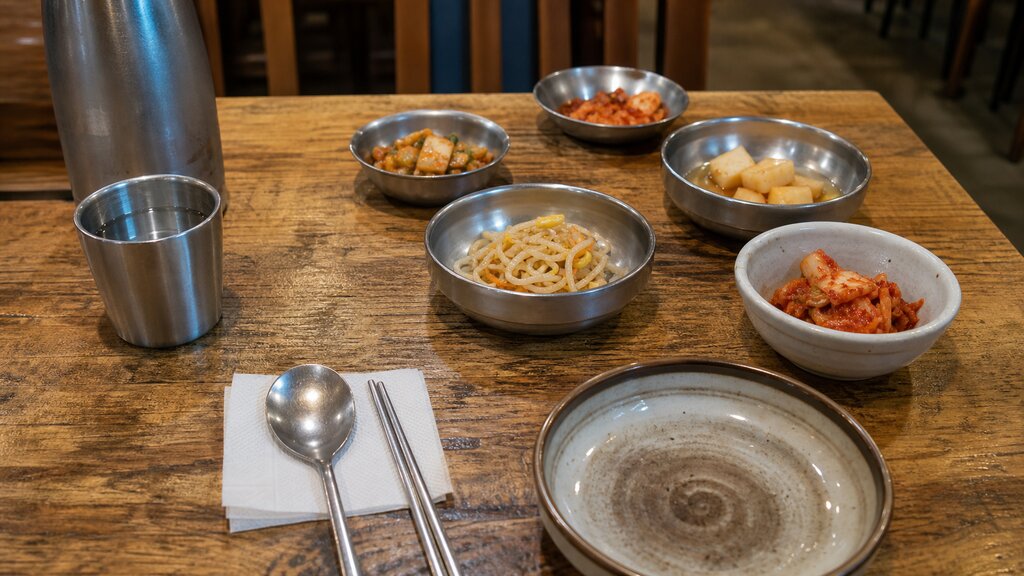
A lot of a Korean table is self-service, and that trips people up too. Water is usually help-yourself — a dispenser or a jug by the counter, with cups stacked beside it. Side dishes (banchan) are free and refillable; you can ask for more or, at many places, grab them from a self-serve station. Utensils, napkins, and sometimes your own tray all live in a drawer under the table or at a station by the door. At casual and self-service spots, you’re expected to carry your tray back to the return window when you’re done. None of this is anyone being lazy — it’s just how the room is built to run, and once you see the pattern you’ll spot it everywhere. The full grill-side version of this — who cooks, when staff step in, how the side dishes work — I laid out in the Korean BBQ guide.
One more that catches people at the door: in some traditional restaurants, tea houses, hanok guesthouses, and every temple, you take your shoes off. The signal is architectural — a raised wooden floor, a step up, or a shoe rack and rows of slippers near the entrance. If you see people’s shoes lined up at a threshold, that’s your cue. Wear socks you don’t mind being seen in, and slip your shoes off before you step up onto the raised floor, not after.
Money, tipping, and shopping
Let me be as clear as I can about tipping, because it’s the question I get more than any other: there is no tipping in Seoul. Not in restaurants, not in taxis, not in cafes, not for hotel staff. It isn’t a reduced-tip culture or a secret 10% — the concept simply isn’t part of how service works here. Leaving extra cash on the table usually creates a small moment of confusion, with staff sometimes chasing you down to return what they assume you forgot. The menu price is the whole price. Keep your change; nobody is offended. I unpacked the wider money picture — cards, cash, budgeting — in the Seoul money guide.
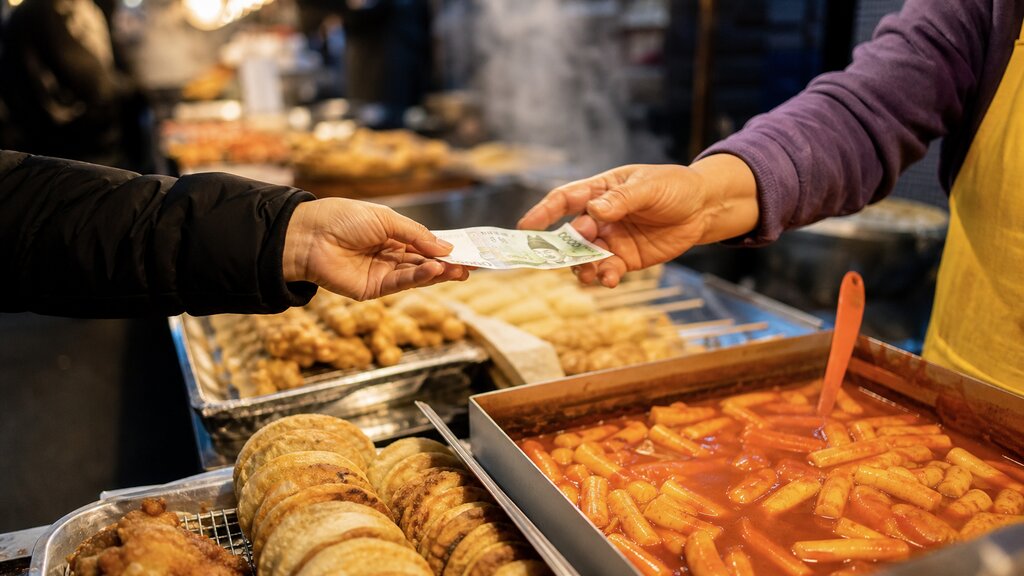
That said, Seoul’s near-cashless reputation has one real exception, and it’s worth planning for. Traditional markets — Gwangjang, Namdaemun, the tented street stalls, that grandmother selling hotteok from a cart — often want cash, or at least prefer it, and the smallest vendors may not take cards at all. Everywhere else your card (foreign cards included) works fine, but I’d keep 30,000 to 50,000 won of small bills in my pocket specifically for market and street-food days. It’s the difference between eating the thing you’re looking at and walking away.
Shopping brings its own small friction, mostly in one place: Myeongdong. The cosmetics-and-skincare touts there are persistent — the “free skin consultation,” the free-sample flyer pressed into your hand, the staff calling you into a store. None of it is a scam exactly, but it’s a hard sell, and the correct response is simply a light “no thank you” (or “gwaenchanayo” — 괜찮아요, “I’m fine”) and keep walking. You don’t owe an explanation, and you won’t cause offense by not stopping. I mapped out the whole area, hard-sell and all, in the Myeongdong guide if that’s on your list.
Taxis without the friction
Taxis in Seoul are cheap, plentiful, and mostly honest — but two things reliably create awkward moments for visitors. Some drivers would rather not take a very short ride, and plenty don’t speak much English. You can dodge both by using KakaoTaxi (the KakaoT app), which has an English interface, lets you set your destination on the map so there’s no pronunciation problem, and shows the driver exactly where you want to go. It’s what I’d point any visitor to before hailing on the street.
If you do flag one down the old-fashioned way, have your destination written in Korean — a screenshot from Naver Map, or the Korean name of your hotel — ready to show. “The Grand Hyatt” spoken aloud in English can land very differently than the Korean text on a screen. From the airport specifically, most first-timers are better off on the train or bus anyway; I compared the options in the Incheon Airport to Myeongdong guide.
The small social cues
A few gentle habits, none of them make-or-break, all of them the kind of thing that makes a local warm to you a little faster.
Koreans may ask your age surprisingly early in a conversation — sometimes within the first few minutes. It reads as blunt if you’re not expecting it, but it isn’t nosiness. Korean has different levels of politeness built into the grammar, and knowing whether you’re older or younger tells the other person how to speak to you correctly. It’s a courtesy question, not an intrusion. A small nod or slight bow is the universal warm default for hello, thank you, and goodbye — you don’t need to study bow angles, just tip your head.
When you hand something to or receive something from an older person, or in any slightly formal moment — a business card, a gift, your payment to a shopkeeper who’s clearly senior — using two hands (or your right hand with your left lightly touching your forearm) reads as respectful. Nobody will scold you for using one, but two hands is a quiet signal that you get it.
If you end up drinking with Koreans, three small customs go a long way: you pour for others rather than filling your own glass, you receive a poured drink with two hands, and when drinking in front of someone clearly senior, you turn your head slightly away from them as you sip. It’s a brief gesture and locals notice it warmly from a foreigner who bothers. And at palaces, temples, and shrines, keep your voice down and dress a little modestly — these are active cultural and religious sites, not just photo backdrops.
The one that actually matters
If I had to compress this whole guide into a single point: none of these are tests you can fail. Seoul does not run on catching foreigners out. Skip every rule on this page and you’ll still have a fine trip, because the city is patient with visitors in a way that genuinely surprises the people who live in stricter places.
What these habits really buy you isn’t safety from offense — it’s ease, and a bit of goodwill. When you leave the priority seat empty, call the waiter with confidence, and wave off the Myeongdong tout with a smile, you stop reading as someone bracing for a foreign country and start reading as someone comfortable in it. That comfort is contagious. Staff relax, strangers help more readily, and the whole trip gets a little warmer. That’s the entire point of this list — not fear, just ease.
— Bo
FAQ
Do I need to tip in Seoul? No. Tipping isn’t practiced anywhere in Seoul — restaurants, taxis, cafes, or hotels — and the menu or meter price is the full amount. Offering a tip usually just confuses staff, who may assume you left money by mistake.
Is it rude to call a waiter over in Korea? Not at all. Servers don’t hover, so you’re expected to get their attention — press the table call button if there is one, or say “yeogiyo” with a raised hand. What feels impolite elsewhere is the normal, expected way to order here.
Does Google Maps work in Seoul? Only partly. Korea restricts detailed map data, so Google can’t give proper driving or walking directions. Download Naver Map or KakaoMap, both of which have English modes. Google is still usable for subway station-to-station routes.
Do people speak English in Seoul? In tourist areas, hotels, and among younger people, often enough to get by. Elsewhere it can be limited, so it helps to have destinations written in Korean, use a translation app, and choose services like KakaoTaxi with an English interface.
Have a Seoul etiquette question I didn’t cover, or planning your first trip? Start with the first-time-in-Seoul hub or send it through the Contact page.