Hi, I’m Bo, the local voice behind Seoul With Me. Korean BBQ is the meal I get asked about more than any other — and the questions are never really about the meat. They are about the system: why the menu is priced “per person,” why the staff keeps taking your tongs away, whether the twenty small dishes on the table cost extra, and why the couple at the next table seems to be eating lettuce with more confidence than you have ever eaten anything.
I have spent a good share of my adult life at these tables — after-work dinners, family birthdays, and the occasional night of convincing visiting friends that yes, the scissors are normal. This guide is not a list of restaurants. It is the operating manual I wish I could hand every first-timer before they sit down at any grill in the city.
Quick Answer
| Question | Short Answer |
|---|---|
| Typical cost | Roughly 15,000-25,000 KRW per person for pork BBQ with drinks kept modest (mid-2026 city range) |
| How meat is ordered | By portion (1인분, “il-in-bun”) — most tables must order at least 2 portions to start |
| Who grills | You, mostly — staff step in at some restaurants, especially for beef and galbi |
| Side dishes (banchan) | Included, and refills are free — you are not being charged per dish |
| Solo diners | Possible but not the default; many BBQ places expect two people minimum |
| Paying | At the counter by the door, not at the table; cards are accepted almost everywhere |
Prices here are rough city-center ranges as of mid-2026 and vary by cut, neighborhood, and beef versus pork. Treat them as a planning baseline, not a menu.
The Four Kinds of BBQ Restaurant You Will Actually Meet
“Korean BBQ” is not one type of restaurant. Seoul has at least four distinct formats, and knowing which one you walked into explains most of what happens next.
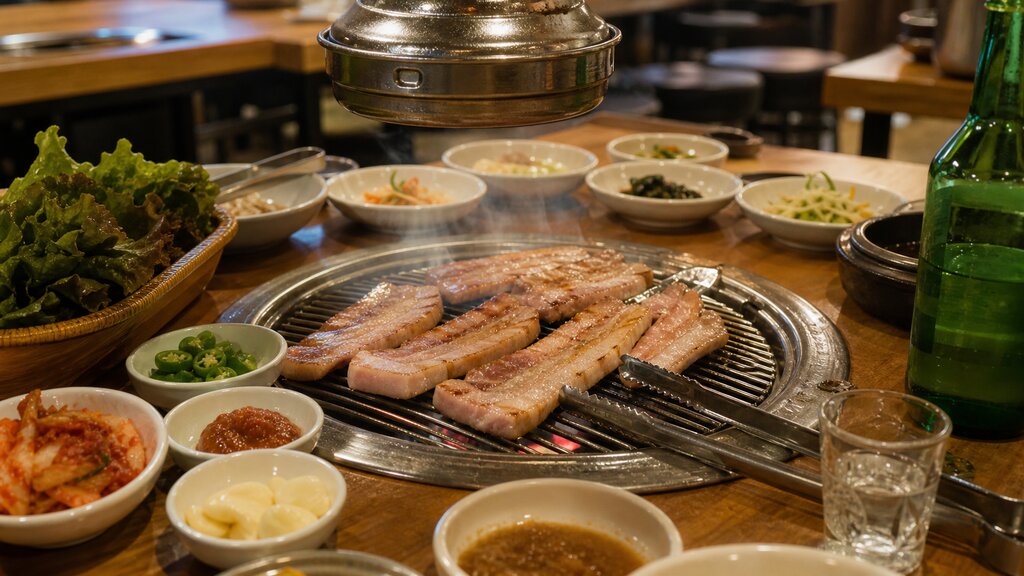
The samgyeopsal joint. The default neighborhood format: pork belly and pork shoulder, metal or stone grills, green soju bottles, loud tables. This is where most Koreans actually eat BBQ on a normal week, and it is the best first-timer format — forgiving cuts, simple ordering, reasonable prices.
The galbi house. A step up in price and ceremony, centered on beef or pork ribs, often marinated (yangnyeom galbi). Staff are more involved with the grilling, tables are calmer, and this is the format Korean families choose for occasions. If someone in Seoul says “let me take you to a good galbi place,” they are being generous.
The all-you-can-eat buffet. Fixed price, self-serve raw meat from a refrigerated bar, grill it yourself. Quality ranges from decent to purely functional. I would not send you here for your first Korean BBQ memory, but for a group on a budget it does exactly what it promises.
The butcher-shop restaurant (정육식당). You pick raw meat at a butcher counter by weight, pay meat-shop prices, then pay a small per-person grilling fee to eat it on site. Locals love this format for good meat at fair prices. The flow is confusing the first time, so I would save it for your second or third BBQ night — but it is often the best value-for-quality in the city.
If you are staying around Hongdae, you will see all four formats within a ten-minute walk — the grill-restaurant density there is part of why I covered the area’s food scene separately in my Hongdae guide. Myeongdong leans more toward tourist-adapted BBQ with English menus and staff grilling, which is a gentler on-ramp — more on that in the Myeongdong guide.
Ordering: The Portion System Nobody Explains
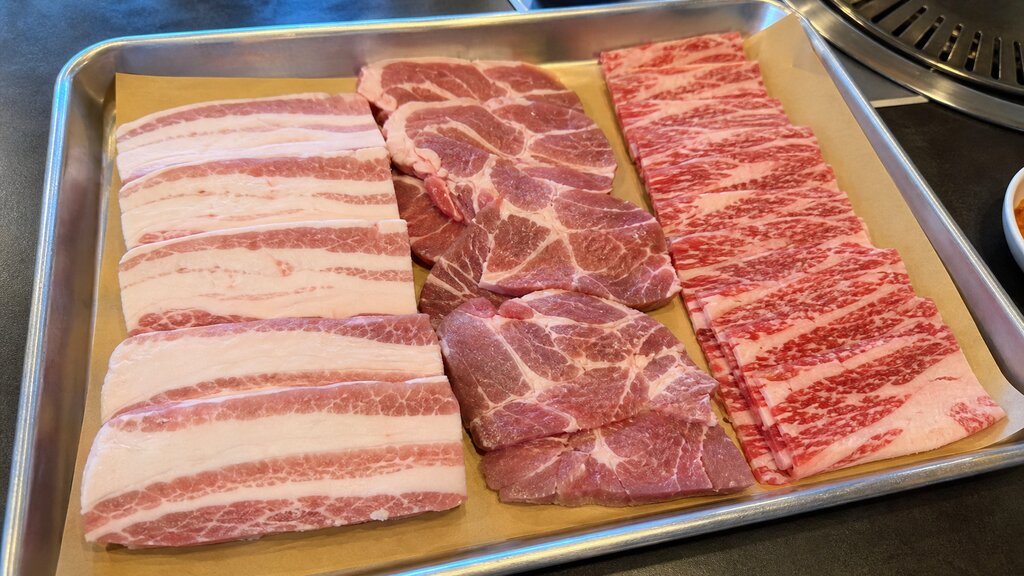
Korean BBQ menus price meat by the portion — 1인분 (il-in-bun), literally “one person’s amount,” usually somewhere between 120g and 180g depending on the cut and the restaurant. Two things follow from this that surprise visitors:
Most restaurants expect a minimum of two portions to fire up the grill. A table of two ordering two portions is the standard opening move. You then add portions one at a time as you go — and almost everyone adds. Opening with the minimum and re-ordering is normal, not stingy.
“One portion” is not a full meal. It is a unit. A reasonable plan for two hungry people is three to four portions of meat plus a stew or noodles at the end.
The cuts you will see everywhere, in the order I would introduce them to a first-timer:
| Korean name | What it is | First-timer notes |
|---|---|---|
| Samgyeopsal (삼겹살) | Pork belly, unmarinated | The national default. Fatty, forgiving, hard to ruin |
| Moksal (목살) | Pork shoulder/neck | Leaner than belly, more meat flavor — my usual second order |
| Yangnyeom galbi (양념갈비) | Marinated ribs, pork or beef | Sweet-soy marinade; the crowd-pleaser for people unsure about “plain grilled meat” |
| Chadolbagi (차돌박이) | Paper-thin beef brisket | Cooks in seconds — do not walk away from it |
| Galmaegisal (갈매기살) | Pork skirt | A local favorite; chewier, deeper flavor |
| Hangjeongsal (항정살) | Pork jowl | Pale, marbled, slightly springy — order it when you see it |
As a rough mid-2026 city-center range, unmarinated pork cuts mostly sit around 14,000-20,000 KRW per portion, marinated and specialty cuts a bit higher, and beef substantially higher — good Korean beef (hanwoo) plays in a different price league entirely. Prices drop noticeably outside the busiest tourist zones.
⚠️ Prices are based on information available at the time of writing and may have changed. Check the menu at the restaurant before ordering.
Who Actually Does the Grilling
The honest answer: it depends on the restaurant, and both versions are normal.
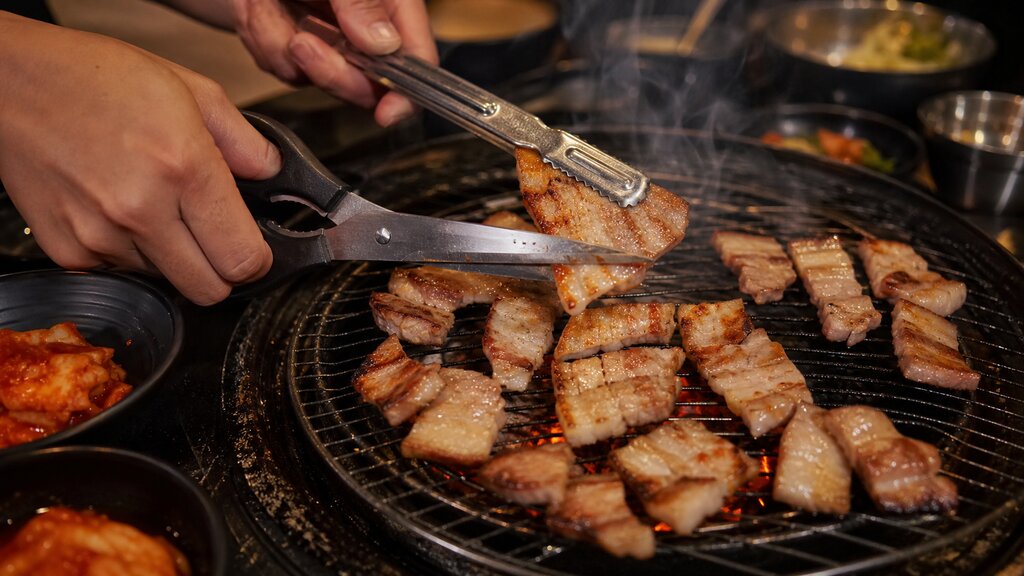
At everyday samgyeopsal places, you grill. The staff will bring the meat, maybe lay the first batch down, and leave you the tongs and scissors. The scissors are not a quirk — they are the correct tool, and cutting meat mid-grill with scissors is something you will be doing yourself by the end of the night. Flip the meat a few times, cut it into bite-size pieces once it firms up, and move cooked pieces to the cooler edge of the grill.
At galbi houses and tourist-adapted places, staff grill for you, either fully or at the tricky stages. Do not fight them for the tongs. It is their grill, they know its hot spots, and a good grilling ajumma produces strictly better results than a first-timer guessing at charcoal temperature.
Two practical notes from years of these dinners: ask for a grill-plate change (불판 교체) when the surface gets carbonized — it is free and staff do it without ceremony. And if the restaurant clips a paper bib or apron on you, accept it. Pork fat commits to cotton shirts permanently.
The Side-Dish and Ssam System
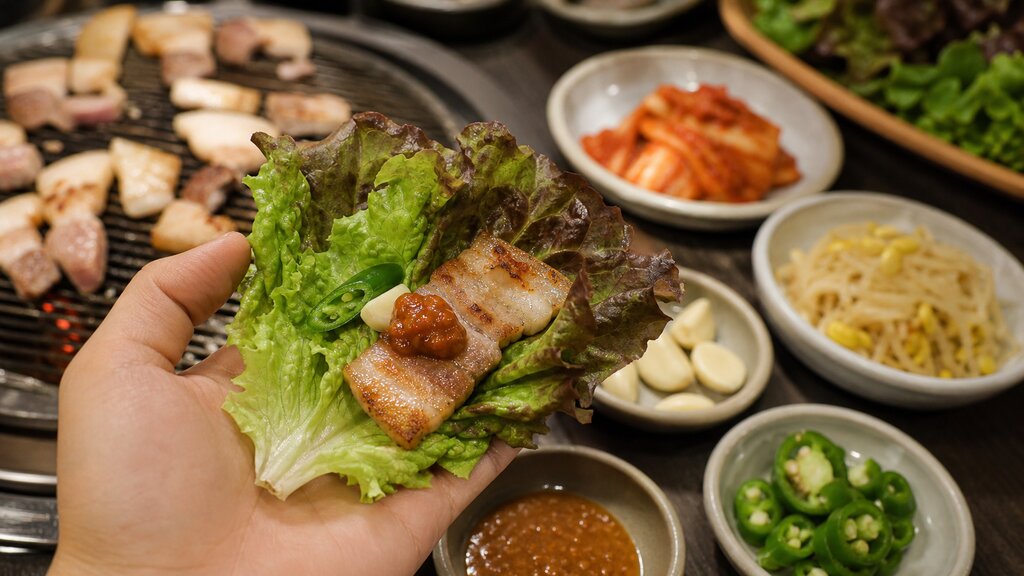
The small dishes that arrive before your meat — kimchi, bean sprouts, salad, garlic, peppers, dipping sauces — are banchan, and they are included. Refills are free; either press the table bell, or at many places you refill yourself from a self-serve bar. No one is running a tab on your kimchi.
The lettuce and perilla leaves are for ssam — the wrap. The full local version: leaf on palm, piece of meat, dab of ssamjang (the thick brown paste), maybe grilled garlic or kimchi, fold it shut, and eat it in one bite. The one-bite part is real technique, not a dare — a half-bitten ssam structurally fails. Start with smaller wraps until your architecture improves.
The ending move matters too. Koreans usually close a BBQ meal with something starchy or brothy: doenjang jjigae (soybean-paste stew), naengmyeon (cold noodles — especially after beef), or fried rice made in the leftover fat. When the meat feels like almost enough, that is the moment to order the stew, not more meat. It is cheaper and it is how the meal is designed to land.
Drinks, Paying, and Other Mechanics
Drinks. Soju and beer are the standard pairing, and somaek — soju mixed into beer — is the standard way to make a Tuesday feel like a Friday. A bottle of soju at a BBQ restaurant runs around 5,000-7,000 KRW in mid-2026, noticeably more than the convenience-store price, which is normal restaurant markup, not a tourist charge. Nobody will blink if you drink water or cola instead.
Paying. With rare exceptions, you pay at the counter near the door on your way out, not at the table. Take the table’s order slip or just tell them your table number. Cards are accepted essentially everywhere — including foreign cards at any place a visitor is likely to walk into — and splitting one bill across several cards is usually tolerated but not loved at busy hours. I covered the broader card-versus-cash picture in my Seoul money guide; the short version is that your card will almost never be the problem at a BBQ restaurant.
Tipping. None. Not reduced, not optional — structurally absent. The bell on the table is how you give good service a chance to happen.
Eating BBQ Alone: The Honest Version
This is the part I answer carefully, because the truth is mixed. Traditional BBQ restaurants are built around tables of two or more — the two-portion minimum exists because a grill, charcoal, and a full banchan spread do not make economic sense for one diner. Walking into a busy neighborhood samgyeopsal joint alone at 7 PM on a Friday will get you seated eventually, but it is not the comfortable version of the experience.
That said, solo BBQ (혼고기, “hon-gogi”) is a real and growing category. Some chains and food-court stalls run individual grill stations designed for one person, one portion, no social overhead. They cluster in office districts and student areas — university neighborhoods and the streets around major stations are your best odds. If you are traveling alone, my practical suggestion: aim for a solo-BBQ format place or go at off-peak hours (before 6 PM), and consider basing this particular craving on where you are staying — the where-to-stay guide covers which areas keep late, dense food streets within walking distance of your hotel.
And if the logistics fail you entirely, a galbi lunch special at a calmer hour is the classic solo workaround — lunch menus often waive the group assumptions that dinner enforces.
The Mistakes I Watch First-Timers Make
- Ordering everything at once. Meat keeps arriving faster than a first-timer can grill it, and the last portions sit warm and gray. Open with the minimum; add as you go.
- Grilling the entire surface at once. Use half the grill, keep a cool zone, move finished pieces there. The grill is a workspace, not a display.
- Ignoring the scissors. Whole strips of pork belly do not turn into bite-size pieces by hope. Cut once the surface firms up.
- Treating banchan as a starter course. Pace yourself. It refills, and the meat has not even started.
- Skipping the ending stew or fried rice. The most common regret, usually discovered by watching the next table eat theirs.
- Overpaying for beef on night one. Hanwoo beef is genuinely excellent and genuinely expensive. Pork is the honest heart of everyday Korean BBQ — start there, upgrade later with a working knowledge of the system.
FAQ
How much does Korean BBQ cost in Seoul? For everyday pork BBQ in central Seoul, plan on roughly 15,000-25,000 KRW per person including a modest amount of drinks, as of mid-2026. Marinated cuts and specialty pork run higher, and Korean beef (hanwoo) can multiply the bill several times over.
Do I grill the meat myself at Korean BBQ? Usually yes at everyday pork places — tongs and scissors are left with you. At galbi houses and tourist-oriented restaurants, staff often grill for you, fully or at the tricky stages. Both are normal; let staff take over when they reach for the tongs.
Can I eat Korean BBQ alone in Seoul? Yes, with planning. Traditional places expect a two-portion minimum and suit pairs or groups, but solo-BBQ restaurants with individual grills exist, clustering near office and university areas. Off-peak hours or lunch specials also work well for solo diners.
Are the side dishes at Korean BBQ free? Yes. Banchan (side dishes), lettuce for wrapping, and the dipping sauces are included with your meat order, and refills are free — ring the table bell or use the self-serve bar where there is one.
What should I order first at a Korean BBQ restaurant? Samgyeopsal (pork belly) is the standard first order — two portions for two people, then add more as you go. If plain grilled pork sounds too austere, yangnyeom galbi (sweet marinated ribs) is the friendliest alternative.
Do Korean BBQ restaurants take credit cards? Almost universally, including foreign cards. You pay at the counter by the entrance on your way out rather than at the table, and tipping is not part of the system.
My Take
Korean BBQ is the least fragile meal in Seoul. The system looks intimidating from the outside — the portions, the scissors, the twenty dishes — but it is built to absorb beginners, because every Korean at every other table also had a first time, usually around age six.
If I were designing your first BBQ night: a normal samgyeopsal place in whatever neighborhood you are sleeping in, two portions of pork belly and one of moksal between two people, one bottle of soju to see how somaek treats you, doenjang jjigae to finish, and the confidence to press the bell like you have done it for years. Total damage somewhere around 25,000 KRW a head, and you will spend the rest of the trip comparing every meal to it.
Would I take a first-timer to a hanwoo beef house instead? Only if they were paying. The pork table is where the actual culture lives.
Useful Official Links
Want me to cover another Seoul food question or neighborhood? Send a request through the Contact page.