Seoul
Transportation Card Guide 2026: T-money vs Climate Card for
Tourists
Hi, I’m Bo, the local voice behind Seoul With Me. In daily life I
usually get around Seoul by car, so I do not think about transportation
cards every morning the way a commuter does. But whenever friends or
visitors come to Korea, the same question comes up almost immediately:
“What card should I buy for the subway?”
My answer used to be almost automatic: buy a T-money card
first. In 2026, I would make that answer slightly more
careful.
T-money is still the safest default for most visitors because it
works beyond Seoul and does not ask you to predict every ride. But
Seoul’s Climate Card short-term passes now matter for some tourists,
especially if you will stay inside Seoul and ride the subway or bus many
times a day.
So my updated rule is this: start with T-money if you want
flexibility; consider Climate Card if your Seoul-only itinerary is
transit-heavy.
If you are still planning your arrival route, start with my Incheon
Airport to Myeongdong guide first. This article is for the next
step: once you are in Korea, should you buy T-money, Climate Card, or
both?
If your hotel area is not decided yet, my where
to stay in Seoul guide will help you choose a base before you
calculate whether a pass makes sense.
For the full first-trip order, start with my First Time in Seoul
guide and then use this page for the transportation-card
decision.
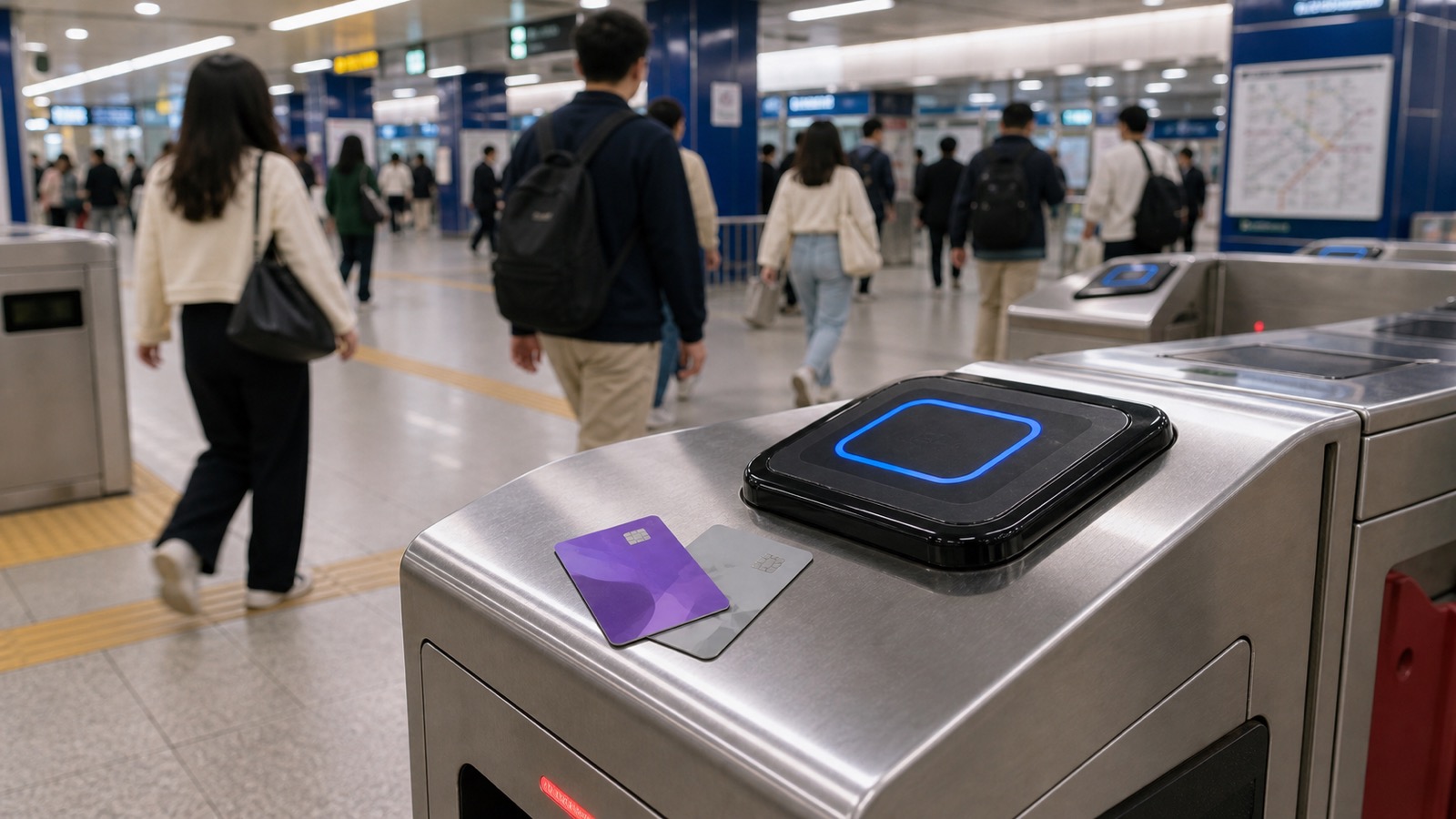
T-money is the flexible default. Climate Card is the Seoul-only
pass to check if your days are packed with subway and bus
rides.
Quick Answer
| Question | Simple Answer |
|---|---|
| Best default for most first-time tourists | T-money |
| Best for Seoul-only, many-rides-per-day itineraries | Climate Card short-term pass |
| Best if you will visit other Korean cities | T-money |
| Best for airport bus, taxis, casual shopping, and flexibility | T-money |
| Climate Card tourist pass prices | 1 day 5,000 KRW, 2 days 8,000 KRW, 3 days 10,000 KRW, 5 days 15,000 KRW, 7 days 20,000 KRW |
| T-money first recharge amount for 2 nights / 3 days | Around 30,000 KRW |
| Can one card be shared by two people? | No, each person should use their own card |
| My simple rule | T-money first unless your Seoul transit days are clearly heavy |
If you only remember one thing, remember this: T-money
reduces confusion; Climate Card can reduce cost if your Seoul-only
transit use is high enough.
What Is T-money?
T-money is Korea’s standard rechargeable transportation card. You add
money to the card, tap it when you ride public transportation, and the
fare is deducted from your balance.
VisitKorea describes T-money and similar cards as prepaid
transportation cards that do not require an account. It also notes that
T-money can be bought and charged at convenience stores nationwide, used
for public transportation, and used at affiliated stores that display
the T-money logo.
That is the reason I recommend it to visitors. You do not need a
Korean phone number, a Korean bank account, or a complicated
registration process just to ride the subway. You buy the card, load
value, and start using it.
There are other cards and passes in Seoul, including the Climate
Card. In 2026, that comparison is worth taking seriously, but T-money is
still the cleaner starting point if your plan includes airports, taxis,
other Korean cities, or loose daily movement.
When the Climate
Card Is Worth Considering
The Climate Card is Seoul’s unlimited public transportation pass.
According to Seoul Metropolitan Government guidance, short-term passes
are available for 1, 2, 3, 5, and 7 days, with prices from 5,000 KRW to
20,000 KRW. The pass covers Seoul-based subway sections, Seoul-licensed
buses, and some connected routes, but it does not cover everything a
tourist may use.
The Climate Card can make sense if all of these are true:
- You will stay mostly inside Seoul.
- You expect several subway or bus rides each day.
- You are not relying on airport limousine buses, taxis, intercity
buses, KTX, or subway sections outside the valid range. - You are comfortable checking the service area before using it on
edge routes.
The Climate Card is less attractive if:
- You will visit Busan, Suwon, Incheon, Jeonju, or other cities.
- You want one card for taxis, convenience stores, and small
payments. - Your Seoul days are slow, walkable, or neighborhood-focused.
- Your first ride is from Incheon Airport and you do not want to think
about coverage exceptions.
Seoul’s official Climate Card page also notes that international
credit and debit cards can be used to purchase and recharge short-term
Climate Card passes at supported machines. That makes the card easier
for foreign visitors than it used to be, but I still would not call it
the universal first card.
My practical rule: if you need to ask, “Will I use the subway enough
to make this pass worth it?”, T-money is probably the easier first
choice. If you already know your Seoul days are packed with transit
rides, check Climate Card before loading too much money onto
T-money.
Where to Buy a T-money Card
The easiest places to buy T-money are:
- Airport convenience stores after arrival
- CU, GS25, 7-Eleven, and emart24 convenience stores in the city
- Subway station information centers on Seoul subway lines 1-8
- Some subway station vending machines or ticket machines
- Travel card counters and tourist-oriented stores
At Incheon Airport, I usually tell visitors to look for a convenience
store after they come out into the arrivals area. It is less stressful
than trying to understand every ticket machine while holding luggage and
checking hotel directions at the same time.
If you are already in Seoul, a convenience store near your hotel is
usually enough. Walk in, say “T-money card,” choose a design, and ask to
load money. Some cards have characters or special designs, so the card
price can vary. The stored balance is separate from the card purchase
price, and the card purchase price itself is generally not
refundable.
For first-time visitors, buying and loading the card at a
convenience store often feels less rushed than starting at a station
machine.
How Much Should You Load?
For most visitors, the mistake is not loading too little. You can
reload almost anywhere. The bigger mistake is loading too much on the
first day and then trying to solve a leftover balance problem at the
airport.
Here is the amount I would suggest if a friend asked me:
| Trip Length | First T-money Load | Why |
|---|---|---|
| 1 day in Seoul | 10,000-15,000 KRW | Enough for a few rides and a small buffer |
| 2 nights / 3 days | About 30,000 KRW | Comfortable for subway, bus, and route changes |
| 4-5 days | 40,000 KRW | Good if you move around different neighborhoods |
| About 1 week | About 50,000 KRW | Convenient, but still not too much to spend down |
| Heavy transit days | Add 10,000-20,000 KRW as needed | Reload after you understand your pace |
These are not official package prices. They are practical starting
amounts. Seoul transit fares depend on distance and transport type, and
a normal day can vary a lot. A slow day around one neighborhood may use
very little. A day that goes from Myeongdong to Gyeongbokgung, Seongsu,
Hongdae, and back to the hotel will use more.
My local habit when helping visitors is simple: start around 30,000
KRW for a short trip, then check the balance at gates, machines, or
convenience stores. If the balance starts to feel low, recharge before a
busy day rather than waiting until you are rushing for the last
train.
Where T-money Works
T-money is useful because it covers the situations most tourists
actually run into.
You can generally use it for:
- Seoul subway and metropolitan subway rides
- Seoul city buses and many local buses around Korea
- Public transportation in many other Korean cities
- Many taxis with a T-money or transportation card reader
- Airport shuttles and some bus services where T-money is
accepted - Convenience stores and affiliated stores displaying the T-money
logo - Some vending machines, public phones, lockers, and station
facilities
The exact acceptance can vary by store, taxi, or local service, so do
not treat T-money as a replacement for a credit card or cash. Think of
it as your transit card first and a useful small-payment backup
second.
One practical point: if you plan to visit Busan, Suwon, Incheon,
Jeonju, or other places outside Seoul, T-money is still the safer card
to keep in your wallet. Climate Card has a service range, while T-money
is the more flexible Korea-wide transit habit.
How to Use T-money on
the Subway and Bus
The subway habit is straightforward:
- Tap your card at the gate when entering.
- Keep the card with you during the ride.
- Tap again at the gate when exiting.
For buses, do this:
- Tap when boarding.
- Tap again when getting off.
- Do not forget the exit tap, especially if you are transferring.
Seoul’s official bus guidance says transfer discounts require tapping
when getting off, and transfers are generally within 30 minutes after
tapping off, with a longer window during late night and early morning
hours. This is one of the details visitors miss because in some
countries you only tap once.
In Korea, I would build the habit early: tap in, tap
out. On buses, I often remind visitors before the stop because
it is easy to stand up, check your map, and forget the reader by the
back door.
How to Recharge T-money
You can recharge T-money at:
- Convenience store counters
- Subway station ticket vending machines
- Transportation card charging machines in stations
- Some T-money service counters
For short-term visitors, Korean won cash is still the safest
assumption for recharging. Some purchase or payment situations may
accept cards, but if you rely only on an overseas card at a random
machine, you may waste time. I would keep small bills such as 10,000 KRW
notes for recharging, especially during the first few days.
At a convenience store, hand over the card and cash and say the
amount you want to add. At a subway station machine, choose the recharge
option, place the card on the reader, insert cash, and wait until the
machine confirms the recharge.
Do not remove the card too early. It sounds obvious, but I have seen
visitors lift the card as soon as the screen changes and then wonder if
the recharge finished. Wait for the completion message.
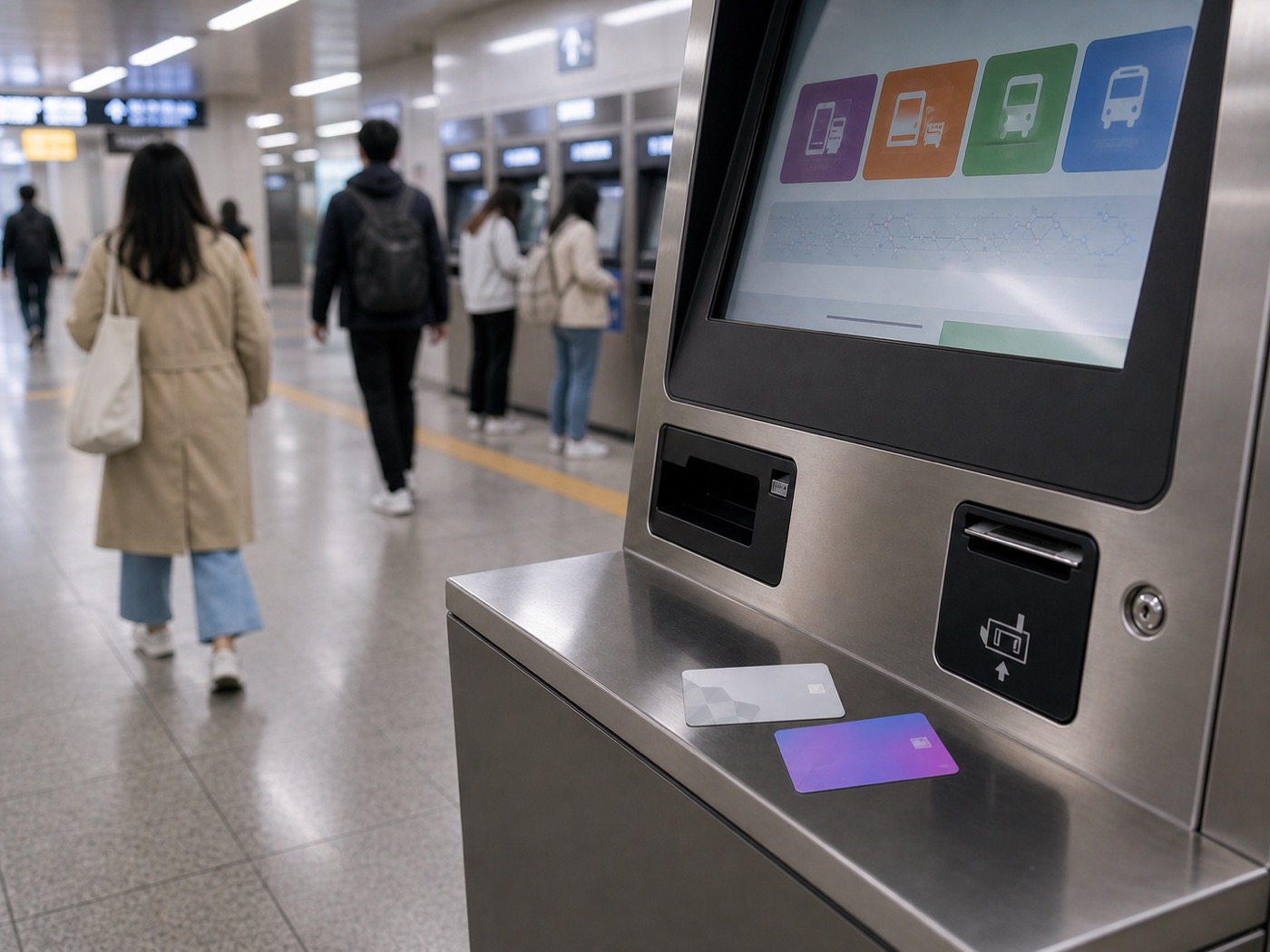
Station machines are useful once you understand the basic flow:
choose recharge, place the card, add cash, and wait for the
confirmation.
Can You Use One
T-money Card for Two People?
For normal subway and bus travel, each person should have their own
T-money card.
This is one of the questions visitors ask me surprisingly often. It
sounds reasonable: if the card just has money on it, why not tap twice?
In practice, Seoul’s subway gates and transfer system are designed
around one card per rider. If two people are traveling together, buy two
cards.
It also makes transfers cleaner. Each traveler has their own ride
history, their own transfer discount tracking, and their own balance.
The card itself is cheap enough that sharing is not worth the
confusion.
What to Do With Leftover
Balance
Near the end of your trip, check the remaining balance before you
arrive at the airport. You have three realistic options.
Option 1: Spend It Down
This is my favorite option for small balances. Use the remaining
T-money value at a convenience store that accepts it. Buy water, snacks,
coffee, or something you actually need before leaving.
This is often simpler than asking for a refund, especially if your
balance is not large.
Option 2: Refund the Balance
Refunds are possible, but the process depends on the remaining amount
and location.
The 2026 Seoul guidebook says T-money balances of 30,000 KRW or less
can be refunded at CU, MINISTOP, and emart24; 20,000 KRW or less can be
refunded at 7-ELEVEN, individual convenience stores, and some street
charging stations; less than 20,000 KRW can be refunded at GS25; and
50,000 KRW or less can be refunded at information centers in subway
stations. VisitKorea also notes that refunds over 50,000 KRW are only
possible at Tmoney Town near Seoul Station.
Refund policies can change by card type and store, and a small fee
may apply. For a short trip, I would avoid creating a large refund
problem in the first place.
Option 3: Keep the Card
If you think you may return to Korea, keeping the card is reasonable.
The card is small, and having one ready for the next trip is
convenient.
Just remember that designs and card types can change over time, and
old cards are not always the cleanest option forever. For most visitors,
spending down or refunding a small balance is the simpler ending.
Common Visitor Questions I
Hear
The questions visitors ask are usually not technical. They are
practical.
“Can I buy it at the airport?” Yes. Look for an airport convenience
store.
“Can I use my credit card instead?” Sometimes for regular payments,
but for Seoul public transportation, a prepaid transportation card is
still the smoother choice for many visitors.
“Should I buy a special tourist card?” Maybe, if you want bundled
benefits. But if your main goal is subway, bus, taxi, and convenience
store use, start with T-money.
“How do I know the balance?” Subway gates usually show it briefly
when you tap. You can also check at recharge machines or convenience
stores.
These are small questions, but they matter on the ground. When you
are jet-lagged and trying to find the right platform, the best card is
the one that creates the fewest extra decisions.
The card is simple. The hard part is usually deciding your first
route, not the payment method.
Mistakes to Avoid
Loading Too Much on Day One
Start with a useful amount, not your whole transportation budget. You
can always reload.
Forgetting to Tap Off the
Bus
This can affect transfers. When you hear your stop announcement,
prepare your card before the doors open.
Assuming Every Taxi
or Store Will Accept It
Many do, but not all. Keep a normal payment method with you.
Throwing It Away With
Balance Left
Spend it, refund it, or keep it. Do not leave 40,000 KRW sitting on a
card because you loaded too much at the beginning.
Buying a Pass
Before Understanding Your Itinerary
Climate Card can be useful, but do not buy it just because it sounds
cheaper. Check whether your hotel area, daily routes, and day trips
actually stay inside the covered range.
FAQ
Is T-money the best transportation card for tourists in
Seoul? For most first-time tourists, yes. T-money is flexible,
easy to buy, and useful on subways, buses, many taxis, and affiliated
stores. Climate Card may be better for Seoul-only travelers who ride
public transport many times per day.
Is Climate Card better than T-money for tourists? It
depends on your itinerary. Climate Card can save money on Seoul-only,
transit-heavy days, but T-money is better for airports, other Korean
cities, taxis, small payments, and flexible movement.
Where can tourists buy a T-money card in Korea?
Tourists can buy T-money at airport convenience stores, CU, GS25,
7-Eleven, emart24, subway station information centers, and some station
vending machines.
How much should I load on T-money for 3 days in
Seoul? For 2 nights and 3 days, I would start with about 30,000
KRW. If you ride less, spend the leftover balance at convenience stores.
If you ride more, recharge during the trip.
Can I use Climate Card from Incheon Airport to
Seoul? Do not assume it works for every airport route. Climate
Card has specific service ranges and exceptions, while airport limousine
buses and some airport-related routes may require separate payment.
Check the route before relying on it.
Can I pay for T-money recharge with an overseas credit
card? Do not rely on it. For short-term visitors, Korean won
cash is the safest way to recharge T-money at convenience stores and
subway machines.
Can I refund my T-money balance before leaving
Korea? Yes, but refund limits depend on the place and remaining
balance. Small balances can often be handled at convenience stores,
while larger refunds may require subway station information centers or
Tmoney Town near Seoul Station.
My Take
If a friend lands in Seoul and asks me what to do first, I still do
not start with every pass and exception. I say: buy a T-money card at
the airport if you want the lowest-friction start. Then, if your Seoul
days are packed with subway and bus rides, compare a Climate Card
short-term pass before adding too much more balance.
That advice is not mathematically perfect for every itinerary. It is
just the answer that prevents the most confusion for the most
visitors.
T-money works because it is boring in the right way. It does not ask
you to predict every ride. Climate Card works when you can predict your
Seoul transit pattern well enough to benefit from unlimited rides. Those
are different strengths, and mixing them up is where tourists waste
time.
Rating: 4.5/5 for T-money as the flexible first card; 4/5 for
Climate Card when your Seoul-only itinerary is
transit-heavy
Best for T-money: First-time visitors, airport-start trips, Seoul
plus other Korea cities, flexible itineraries
Best for Climate Card: Seoul-only trips with several subway or bus rides
per day
My simple rule: Start with T-money unless the Climate Card math is
obvious for your itinerary.
Want me to cover another Seoul place or Korea travel question? Send a
request through the Contact
page.