Hi, I’m Bo from Seoul With Me, and I want to reset an assumption before you land: in Korea, the convenience store is a place you plan to eat at, not the sad fallback you settle for when everything else is closed. I’m from Gangnam, I’ve lived my whole adult life within a two-minute walk of at least three of them, and I still eat from one several times a week — sometimes standing at the counter after a late night, sometimes on a mat by the river. This is genuinely how the city eats. So instead of telling you a convenience store “will do in a pinch,” I’ll show you how to actually eat well from one.
Foreign shoppers have started treating these stores as a destination too, and sales to overseas customers have climbed sharply in the last couple of years. That tracks with what I see on the street: visitors filming the ramen machine, comparing triangle kimbap flavors, working out the ice-cup thing. You’ve found the real everyday food scene here, not a tourist version of it. Let me walk you through it the way I’d brief a friend flying in.
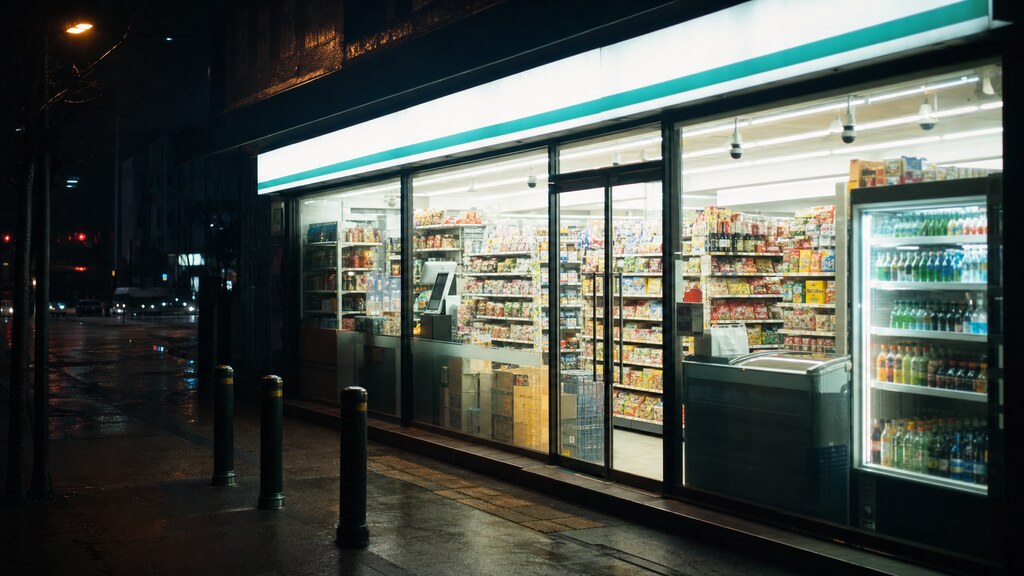
The four chains you’ll see on every block
There are four names you’ll see over and over: CU, GS25, 7-Eleven, and Emart24. Between them they blanket the country — in a dense Seoul neighborhood you’re rarely more than a block from one, and most run 24 hours. You do not need to hunt for a “good” one or memorize which chain is which. For a first-timer they’re close enough that proximity wins; walk into whichever one is nearest and you’ll find the same core lineup.
What’s changed over the years is the food quality. These aren’t dusty snack shops. The chains compete hard on their own-brand fresh food — the lunchboxes, the rice rolls, the chicken — and they refresh it constantly, so the chiller you’re looking at was likely restocked that morning. Each chain also has signature items people are genuinely loyal to, which is why you’ll see Koreans walk past a nearer store to reach a specific one. Don’t overthink that on day one. The gap between chains matters to us because we’re picky about our particular favorite; to you, arriving fresh, all four will feed you well.
One practical note on prices, and I’ll only say it once: everything here is cheap, but the numbers move. A meal built from a convenience store might run you roughly 3,000 to 8,000 KRW depending on how much you pile on, individual items from around 1,000 KRW up. Treat every price in this guide as a rough range, because they shift with time and product.
How the store actually works
The part that trips up most visitors isn’t what to buy — it’s the self-service machinery, so let me demystify it. The centerpiece is instant ramyeon. You grab a cup ramyeon off the shelf, pay for it at the counter first, then peel the lid back to the fill line printed inside. From there it’s one of two systems. Older or smaller stores have a hot-water dispenser: you push the cup up against the spout, hold, and fill to the line yourself. Newer stores have a dedicated ramen machine — you set the sealed cup into a well, press the button matching the cook time on the lid (usually somewhere around three to five minutes), and the machine doses the hot water and runs a timer for you. Either way, no kettle and no Korean needed.
Most stores also keep a microwave for heating lunchboxes and steamed buns, a stack of disposable wooden chopsticks and plastic spoons, and napkins near the water station. Look for the little counter along the window, often with stools — that’s the eat-in area, and eating your food right there is completely normal and expected. The etiquette is light but real: clean up after yourself, put your trash in the marked bins (they usually separate food waste from packaging), and during a packed lunch or late-night rush, don’t camp at the counter for an hour. Eat, tidy, move on. It’s the same low-key courtesy I cover in the Seoul etiquette guide, and locals will quietly appreciate you knowing it.
What to buy first
Start with the triangle kimbap. Samgak gimbap is a triangular wedge of rice with a filling in the middle, wrapped in a sheet of dried nori that’s kept crisp by a clever plastic film — you peel it off in three numbered steps so the seaweed wraps around the rice only at the moment you eat it. The first time, the film defeats everyone; follow the numbers on the wrapper in order and it works. This is the single most-bought item in the country, it costs somewhere around 1,000 to 1,800 KRW, and the flavor to start with is tuna mayo — mild, savory, the crowd-pleaser. From there try spicy tuna, bulgogi, or kimchi. Buy two or three; they’re small.
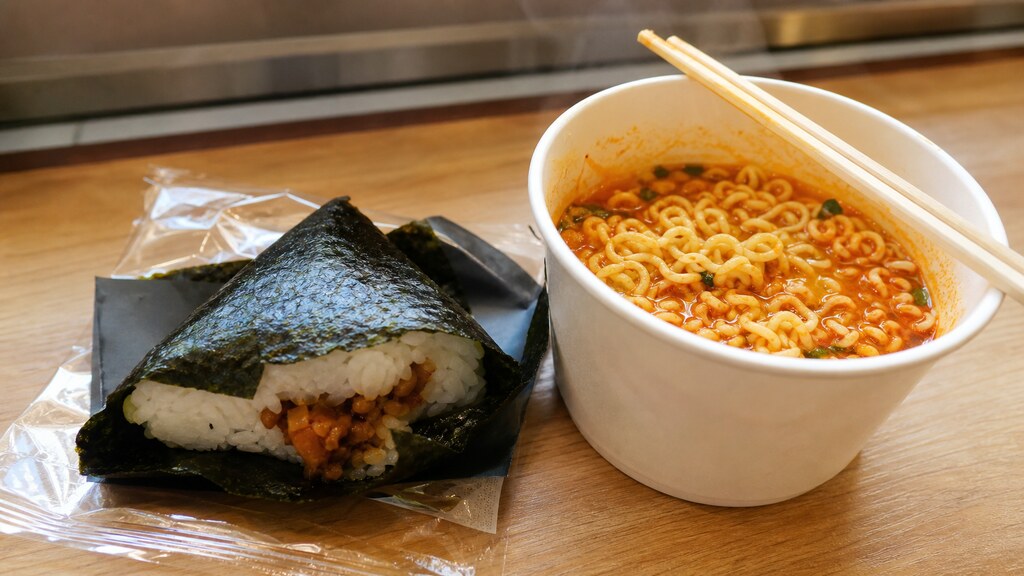
The cup ramyeon is the anchor of the whole meal, and pairing it with a triangle kimbap is the classic move — noodles plus a rice ball is the default cheap lunch for half the country. A few names worth knowing on the shelf: Shin Ramyun is the spicy standard everyone grows up on; Buldak, the fire-chicken line, is the very spicy one that went viral overseas, and I mean genuinely hot, so ease in; Jin Ramen sits milder if heat isn’t your thing. Any of them, cooked at the machine, eaten at the counter, is a proper small meal.
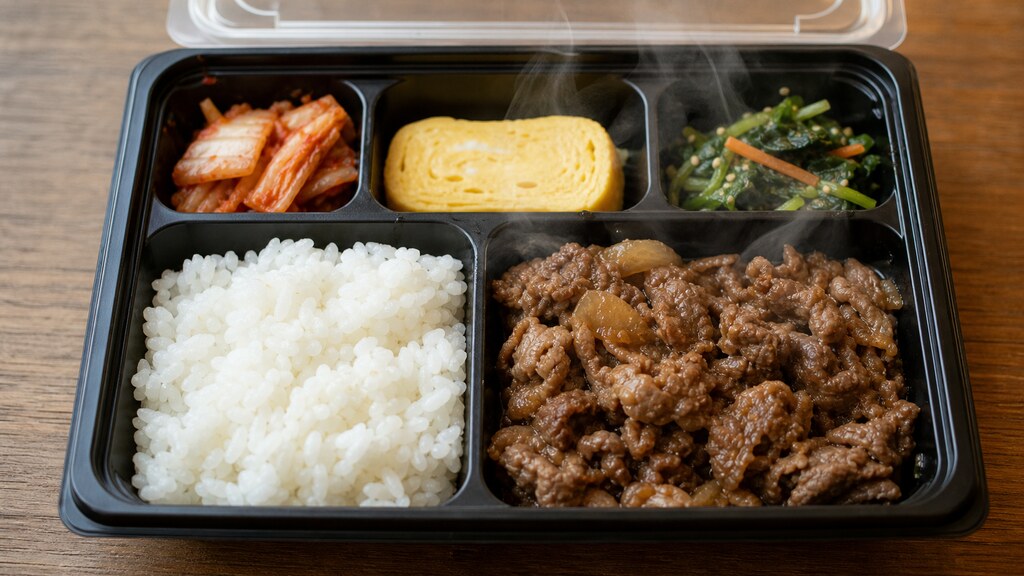
When you want something more filling, get a dosirak — a compartmentalized lunchbox with rice in one section and meat plus a few side dishes in the others. You microwave it in the store (the staff will point you to it, or just look for the machine by the counter), and for something in the rough 4,000 to 6,000 KRW range it’s a real, hot, sit-down-quality meal. Beyond that, the hot-food case near the register is worth a look: corn dogs, cups of tteokbokki, steamed buns, and sausages or hotbars on a stick. In the chiller you’ll also find pre-made sandwiches and rolled gimbap if you’d rather not cook anything at all. That’s the recognizable starter set — a triangle kimbap, a cup ramyeon, maybe a dosirak, and one hot snack.
Drinks, desserts, and the ice-cup trick
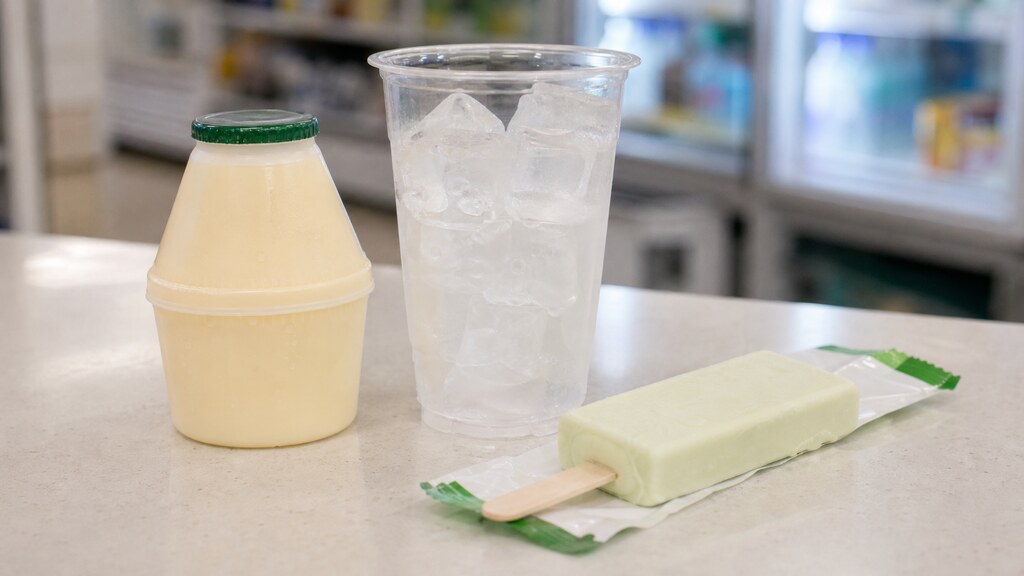
The drink you should try at least once is banana milk. Binggrae’s is the icon — a short, round, slightly squat bottle you’ll recognize instantly once you see it — and it’s sweet, mild, and weirdly nostalgic even on a first taste. It’s been a national staple for decades. Alongside it the freezers hold ice-cream bars (Melona, the pale-green melon one, is a good entry point), yogurt drinks, and every soda and coffee you’d expect.
Then there’s the ice-cup trick, which is the part visitors don’t intuit. Those large cups of ice sold in the freezer aren’t only for a drink you already own — they’re the base of a whole build-your-own drink habit. You buy the cup of ice, grab whatever bottled or canned drink you want, and pour it over the ice at the counter or your seat. Iced coffee, juice, tea, soda — it’s cheaper and colder than buying a pre-made iced drink, and it’s completely routine. Once you’ve done it once you’ll understand why every freezer has a wall of ice cups.
The combos locals actually make
Here’s the fun part, and it’s real — these aren’t influencer stunts, they’re things people around me genuinely order and assemble at the counter. Try any of these:
- Banana milk in iced americano. Buy an iced americano and pour a little banana milk into it. It turns a plain coffee into something like a light sweet latte. Sounds odd, works beautifully.
- The ice-cup mixes. Fill an ice cup with a tonic or energy drink plus a soda — the well-known “eolba” style build. Some of these combos got popular enough that a chain eventually bottled a ready-made version, which tells you people weren’t just doing it for the camera.
- Cup tteokbokki, upgraded. Take a cup of instant tteokbokki, add instant spaghetti or ramyeon noodles and a slice of cheese, then microwave it together. The starch and cheese mellow the spicy-sweet sauce into something genuinely good. This one has a small cult following for a reason.
- Buldak plus cheese. If you’re braving the fire-chicken ramyeon, drop in a stick of string cheese or a slice of cheese to tame the heat. Fair warning on the Buldak family — it is properly spicy, and the cheese is less a garnish than a survival tool. Start below the hottest version if you’re unsure.
Keep it playful and don’t feel you have to do all four. But if you want the actual local experience rather than the tourist one, assembling one of these at the counter is it.
Paying, hours, and the small rules
Payment is the easy part. Cards work almost everywhere, and that includes most foreign credit cards — tap or insert at the counter and you’re done. You can also pay by tapping a T-money transit card, the same one you’d use for the subway and buses, since it doubles as a stored-value card in convenience stores; I explain the money-and-cards picture more fully in the Seoul money guide. Some stores have self-checkout kiosks, which may default to Korean, but the flow is the usual scan-and-tap and there’s always staff a step away if you get stuck.
Hours are the other thing in your favor: the large majority of these stores run 24/7, which is exactly why the late-night culture around them is so strong. Some of my favorite low-key evenings in Seoul have ended at a counter stool at 1 a.m. with a cup ramyeon and a banana milk, watching the street. As for the small rules, they’re the same ones from the eat-in section and worth repeating because they’re the difference between a good guest and an annoying one: bin your own trash, sort it into the right containers, and don’t monopolize a counter seat at peak times. That’s the whole social contract, and it’s an easy one to honor.
Where to eat it: the Han River move
The most genuinely local thing you can do with all this is not eat it in the store at all — it’s to carry it out to the Hangang. Buy your triangle kimbap, a cup ramyeon (or cook it at a riverside park’s own machine), a banana milk, and a snack, spread a mat on the grass, and eat as the sun drops behind the bridges. That combination — convenience-store food and the river at dusk — is, to a lot of us, simply what a good Seoul evening is. It costs almost nothing and beats plenty of restaurants for atmosphere.
I wrote the whole riverside playbook — which park to pick, how the park ramen machines work, getting fried chicken delivered to your mat — in the Han River guide, and it pairs with this post so naturally that I’d read them back to back. And if you want the full contrast, the convenience-store meal sits at the opposite end of the spectrum from a proper sit-down grill night; I covered that side in the Korean BBQ guide. Both are real Seoul. You’ll want to try each.
One last word from the counter
If you take one thing from this: don’t skip the convenience store thinking it’s beneath a proper trip. It’s woven into daily life here, the food is better than it has any right to be for the money, and the little rituals — peeling the kimbap in three steps, timing the ramen machine, mixing an ice-cup drink — are part of understanding how Seoul actually lives, not just how it looks in photos. New in town and building an itinerary? Start from the first-time-in-Seoul hub and slot a convenience-store river picnic into your first free evening.
Walk into the nearest one tonight, buy a triangle kimbap and a cup ramyeon, cook it at the machine, and eat it at the window counter watching the street. That’s the whole thing. It asks almost nothing of you and it’s one of the small pleasures I’d genuinely miss if I ever left.
— Bo
FAQ
What should I buy at a Korean convenience store? Start with a triangle kimbap (samgak gimbap) in tuna mayo and a cup ramyeon — that’s the classic cheap meal locals eat daily. Add a dosirak lunchbox if you want something more filling, a hot snack like a corn dog or tteokbokki cup, and a banana milk to drink. Everything is inexpensive, though prices vary.
How do you cook ramen at a Korean convenience store? Buy a cup ramyeon and pay at the counter, then peel the lid to the fill line. Use either the hot-water dispenser (fill it yourself to the line) or the dedicated ramen machine — set the cup in the well and press the button for the cook time on the lid, and it adds hot water and times it. Wait a few minutes and eat at the in-store counter.
Can you pay with a foreign card at Korean convenience stores? Yes, most foreign credit and debit cards work at the counter by tap or insert. You can also pay by tapping a T-money transit card, which doubles as a stored-value card in these stores. Self-checkout kiosks may default to Korean, but staff are usually right there to help.
What is the best Korean convenience store combo? The most reliable is a cup ramyeon plus a triangle kimbap. For the viral local versions, try banana milk poured into an iced americano, or a cup of tteokbokki microwaved with instant noodles and a slice of cheese. If you’re eating the spicy Buldak fire-chicken ramyeon, add cheese to tame the heat — it’s genuinely hot.
Planning your first Seoul trip? Start at the first-time-in-Seoul hub, or send a question through the Contact page.