Hi, I’m Bo, the local voice behind Seoul With Me, and I’ll start by clearing up the biggest misread visitors have about the Han River: it isn’t a landmark you tick off in twenty minutes. To the people who live here it’s closer to the city’s shared backyard — the place we go to do nothing in particular. My wife and I probably end up on the grass at Yeouido a dozen times a summer, and not once have we gone to “see” the river. We go to sit, eat cup ramen out of a paper bowl, and let the evening pass. That’s the whole activity, and it costs almost nothing.
So this guide isn’t a list of viewpoints. It’s how to actually spend an afternoon and evening by the Hangang the way Seoulites do — which park fits which mood, how the riverside ramen machines work, the trick to getting fried chicken delivered straight to your picnic mat, when the Banpo fountain is worth timing, and how to get around on two wheels or on the water. A few times and dates shift with the season, so I’ll flag where to double-check before you head out.
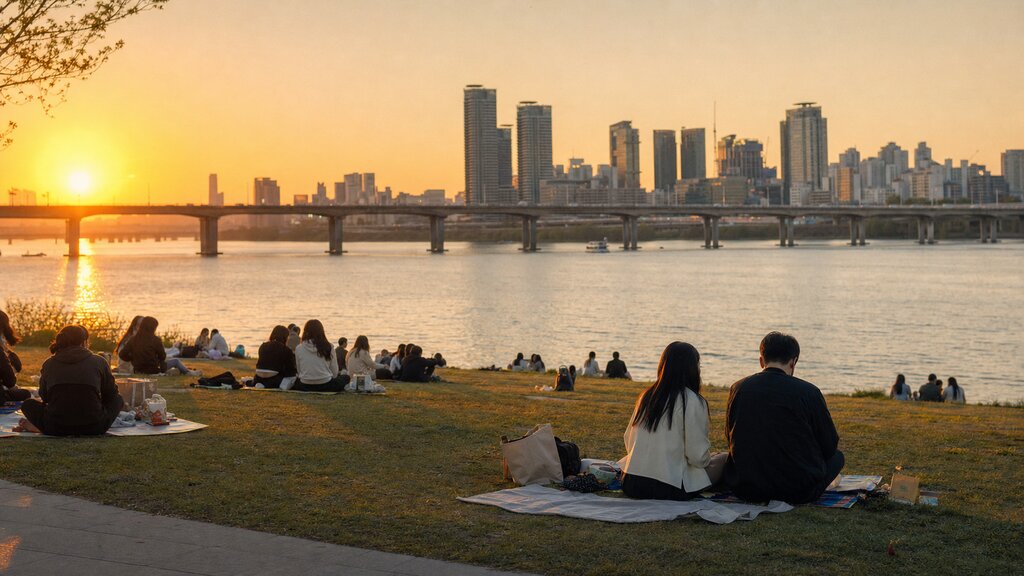
Which stretch of river should you actually pick?
There are eleven or twelve official Hangang Parks strung along both banks, and first-timers get paralyzed trying to compare all of them. You don’t need to. Three cover almost every reason a visitor comes to the river, and the rest are variations on a theme.
Yeouido Hangang Park is where I send anyone asking for the first time. It’s the busiest and the most set up for a spontaneous afternoon — convenience stores every few hundred meters, food stalls, rental kiosks for mats and bikes, and the space to handle a festival-sized crowd without feeling packed. In spring the cherry blossoms behind it draw half the city. If you only have one Han River evening, put it here and you won’t have to plan around anything.
Banpo Hangang Park is the one you save for the night the Banpo Bridge fountain is running. It’s the classic date-night stretch, and the Moonlight Rainbow Fountain arcing off the bridge is genuinely the most photographed thing on the whole river. More on timing that below, because getting there at the wrong hour is the single most common mistake.
Ttukseom Hangang Park sits on the northeast bank right against Seongsu, so it pulls a younger, more design-conscious crowd, and it has an outdoor pool in summer. If you’re already spending a day in the cafes and pop-ups of Seongsu — I mapped that neighborhood in the Seongsu guide — walking down to Ttukseom for sunset is the natural way to close it out.
The others are worth a line. Jamsil, Nanji, Yanghwa, and Gwangnaru all have water-play areas and are quieter family territory; you’d pick them if you’re staying nearby rather than crossing the city for them. If it’s your first time and you want the full picture — ramen, mats, delivery, night lights — go to Yeouido, and swap in Banpo the night you want the fountain.
The convenience-store ramen ritual
If you do one thing by the river, make it this. Most Hangang parks have convenience stores with self-serve instant-ramen machines, and cooking a cup of ramyeon at the machine and eating it cross-legged on a mat by the water is, no exaggeration, the most genuinely Seoul thing a visitor can do here. It’s what “going to the Hangang” means to a lot of us. It also costs about the price of a coffee.
The machine part throws people, so here’s how it works. You grab a cup ramyeon off the shelf, peel the lid back to the line, pay at the counter, then take it to the ramen machine — a small station near the store. You set the cup in the well, press the button for the cook time printed on the lid, and hot water fills it automatically. A short wait, and that’s it. No kettle, no Korean required; it’s built for exactly this. Buy your triangle kimbap, sausages, and a drink from the same store while the noodles cook, and you’ve got the full spread.
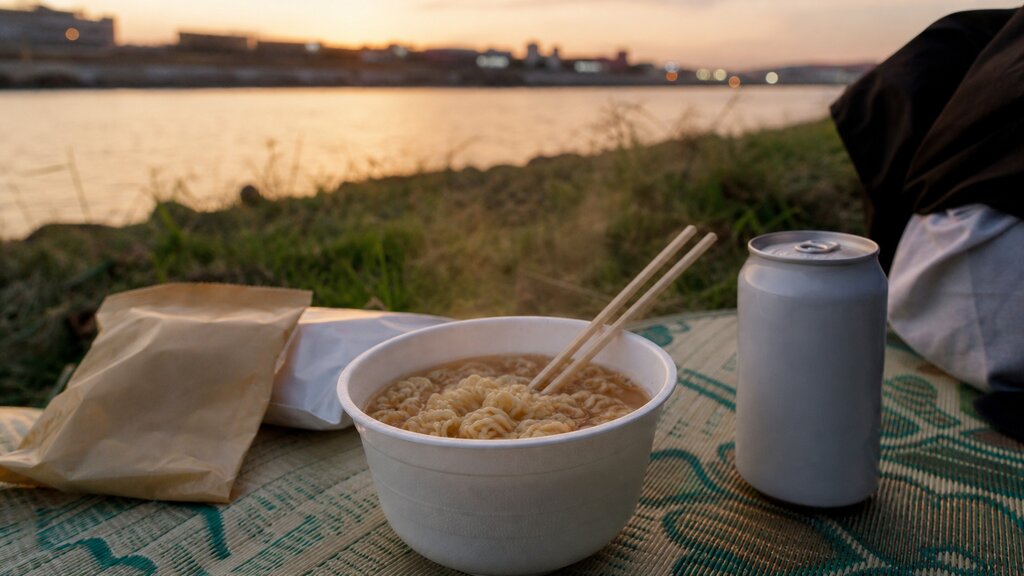
One small thing my wife insists on and she’s right: grab a few extra napkins and a spare bag at the counter. The river breeze is lovely and it also cools ramen fast and blows napkins away, and you’ll want the bag for your trash later. That’s the ritual — cheap, warm, slightly messy, and better than it has any right to be.
Getting chimaek delivered to your picnic mat
Here’s the move most visitors don’t know is even possible: you can have hot food delivered directly to the riverbank. The classic order is chimaek — chicken plus maekju, fried chicken and beer — and getting a box of it handed to you on the grass at sunset is a rite of passage for Seoulites, not a tourist gimmick.
The part that makes it work is the delivery zones. Major parks are divided into marked pickup points with big signs — Delivery Zone 1, Delivery Zone 2, and so on — because “somewhere on the Yeouido lawn” is useless to a driver. So when you order, you set your delivery address to the nearest delivery-zone marker, then walk over and meet the driver there when they arrive. Note your zone number before you spread out your mat so you’re not hunting for it later.
The honest caveat: most Korean delivery apps run in Korean, and payment usually wants a Korean card or account. A couple of apps have English options, and your hotel front desk or even the convenience-store staff can sometimes help you place an order. If it’s your first evening and the app is fighting you, don’t force it — the convenience-store spread above needs no app at all, and you can save chimaek delivery for later in the trip. If you want the bigger picture on cards, cash, and paying for things like delivery in Seoul, I went through it in the Seoul money guide.
Picnicking properly: mats, tents, and the rules
Bring a mat, because the grass is patchy and often a little damp near the water. You can pack a cheap foldable one or rent a mat at the riverside kiosks along with a bike; either way you’ll want something between you and the ground. This is the base layer of every Hangang afternoon, and it’s the thing people forget.
The tents are where visitors accidentally break a rule. Those small sunshade tents you’ll see — roughly 2m by 2m — are allowed only in designated zones, only during daytime, and here’s the part that catches people: by rule at least two sides have to stay open, so the inside is visible. Fully closed tents aren’t permitted. They also have to come down by evening — figure around 19:00, stretched to about 20:00 in mid-summer — and the exact hours and zones vary by park and season, so read the current signs when you arrive rather than trusting a number from a blog, including mine.
The trash rule is simpler and I’ll say it plainly: pack out what you bring. The bins fill fast on a busy evening, and a pretty riverbank turns grim quickly when everyone assumes someone else will deal with it. Bag your own and you’re a good guest. And if you can time your visit to early April, the cherry blossoms around Yeouido turn the whole picnic into something else entirely — just know you’ll be sharing the lawn with a large slice of Seoul.
The Banpo rainbow fountain, timed right
The Banpo Bridge Moonlight Rainbow Fountain is free, it’s genuinely worth seeing, and it’s also the thing people most often show up for at the wrong time. So let’s get the timing right. It runs seasonally — roughly mid-March to the end of October, with 2026 dates around March 16 to October 31 — and it does not run in winter at all. If you’re visiting between November and early March, cross it off; the bridge will just be a bridge.
During the season, evening shows commonly run around 19:30, 20:00, 20:30, and 21:00, with an extra show near 21:30 added in July and August, plus a midday 12:00 show. Each one lasts about 20 minutes, with water fanning off the sides of the bridge lit in shifting colors. It’s weather-dependent — strong wind or rain cancels it, no notice — so it’s never a guarantee. My advice: aim for the roughly 20:00 to 20:30 window from the Banpo Hangang Park side, near the Moonlight Square area, where you’re looking at the bridge with the water arcing toward you. Get there a bit early to sit down before it starts.
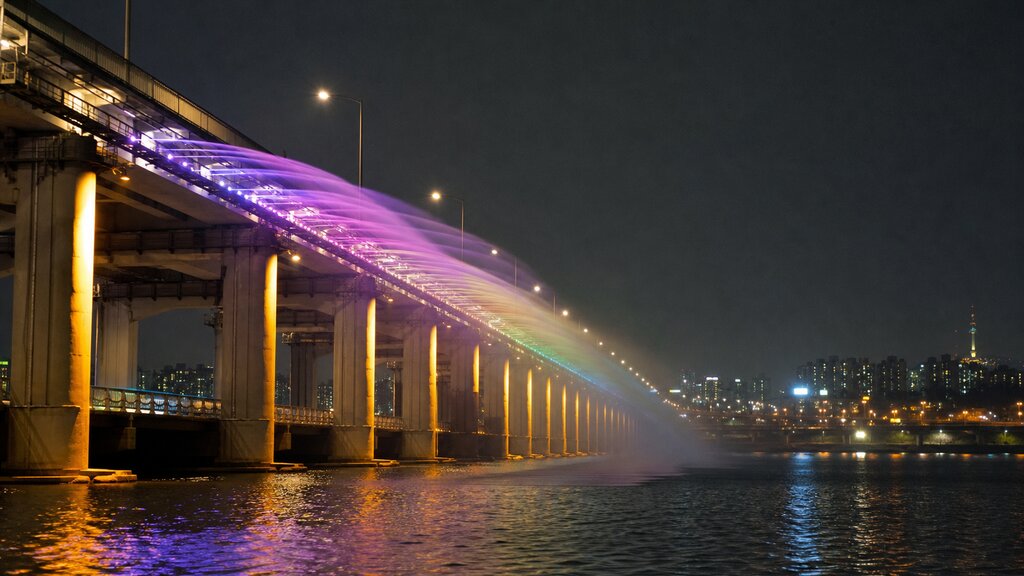
Because the season, the show times, and cancellations all shift, don’t build a whole evening around it on faith — check the current schedule before you go. VisitSeoul keeps updated listings on VisitSeoul, and it’s worth a thirty-second look the afternoon of. A fountain evening pairs well with dinner beforehand somewhere across the water; if you want a riverside cafe with a Hangang view earlier in the day, I wrote up Urban Plant in Yongsan.
On two wheels and on the water
The riverside paths are flat, uninterrupted, and made for cycling, which makes a bike the best way to cover ground between parks. Seoul’s public bike-share, Ttareungi, has docking stations all along the river, and once you’ve sorted a fare card the whole system opens up — I walked through the card basics, which double for the subway that gets you to every park, in the Seoul transport card guide. Renting a mat-and-bike combo at a riverside kiosk is the low-effort alternative if the app setup feels like too much on day one.
For getting on the water rather than beside it, there’s a new option. The Hangang Bus, a river water-bus service, launched in September 2025 and runs along the river between several piers, roughly from the Magok area down to Jamsil. It’s pitched as both a scenic ride and a commute, and because it’s still new, routes, fares, and operating status are exactly the kind of thing that changes — confirm the current details officially before you count on it for a specific trip.
If you’d rather a classic night-view float, the evening river cruises from around the Yeouido area have been running for years and deliver the postcard version — bridges lit up, skyline sliding past — without any of the newness risk. And the simplest point of all: nearly every Hangang park connects to a subway station within walking distance, so you never actually need a car to reach the water.
Day versus night, and when to go
Sunset is the sweet spot, and I’ll die on this hill. Arrive an hour or so before the sun drops, claim your mat while it’s still light, eat as the sky turns, and stay as the bridges and skyline light up across the water. You get the daytime ease and the night view in one sitting without moving. Midday in summer, by contrast, is hot and shadeless on the open lawns — fine for the pools, less so for lounging.
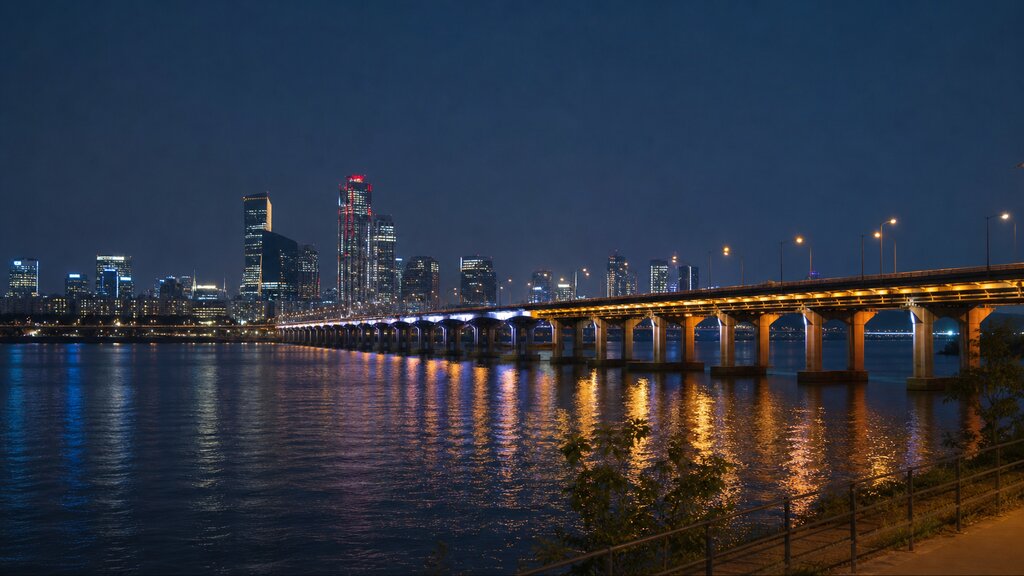
Summer nights are the river’s peak. The outdoor pools at Yeouido and Ttukseom open for the season, with night swimming in the hottest stretch, and several parks — Jamsil, Nanji, Yanghwa, Gwangnaru — run water-play areas for families. It’s summer-only and dates get set year by year, so check before planning a pool day around it. As for crowds: weekend evenings at Yeouido and Banpo are genuinely busy, warm and lively rather than unpleasant, but if you want room to breathe, a weekday evening at Ttukseom or one of the quieter parks gets you the same river with half the people. The river at night — lit bridges, the skyline, the fountain — is one of the best free things Seoul offers, and it barely matters which park you choose to watch it from.
One last word from the grass
If you take one thing from all this: don’t treat the Hangang as a sight. Treat it as an evening. Buy a cup ramyeon, cook it at the machine, spread a mat at Yeouido or Ttukseom around sunset, and let the city do its slow thing around you. Add the Banpo fountain if the season and the schedule line up, and get chimaek delivered once you’ve found your feet with the apps.
That’s how we actually use the river, and it’s the version I’d hand a friend flying in. It asks almost nothing of you and gives back a genuinely good night. Just glance at the current fountain and pool dates before you go, since those move — and then stop planning, and go sit by the water.
— Bo
FAQ
Can you have food delivered to the Han River? Yes. Major Hangang parks have marked delivery-zone pickup points, and you set your delivery address to the nearest zone marker, then meet the driver there. The classic order is chimaek — fried chicken and beer. Most delivery apps are in Korean and want a Korean payment method, so a hotel desk or an English-enabled app helps.
How do you make ramen at the Han River? Buy a cup ramyeon at a park convenience store, pay, then take it to the self-serve ramen machine nearby. Set the cup in the well, press the button for the cook time on the lid, and hot water fills it automatically. Grab snacks and a drink from the same store and eat it on a mat by the water.
When is the Banpo Bridge rainbow fountain on? It runs seasonally, roughly mid-March to the end of October — around March 16 to October 31 in 2026 — and not in winter. Evening shows commonly run near 19:30, 20:00, 20:30, and 21:00 (plus about 21:30 in July–August) and a 12:00 midday show, each about 20 minutes. It’s free and weather-dependent, so confirm the current schedule before going.
Which Han River park is best for first-time visitors? Yeouido Hangang Park. It’s the liveliest and best set up for a spontaneous evening, with convenience stores, food stalls, and rental kiosks all in reach. Switch to Banpo the night you want the fountain, or Ttukseom if you’re already spending the day in Seongsu.
Planning your first Seoul trip? Start at the first-time-in-Seoul hub, or send a question through the Contact page.