Hi, I’m Bo from Seoul With Me, and I’ll be straight with you from the first line: I am not a skincare person. My own routine is three steps on a good day. But I live in Gangnam, my wife and half my friends shop these stores constantly, and the question I get asked more than any other by visiting friends is some version of “where do I buy the Korean skincare stuff?” So I stopped guessing and worked out how the retail side of this actually functions.
Here’s the thing nobody tells you. Almost every K-beauty article online answers “what should I buy,” and that’s the wrong first question. Your budget is decided a step earlier, by where you walk in. The same category of product — a sheet mask, a sunscreen, a lip tint — exists in four completely different kinds of shops in this city, at prices that can differ by a factor of five, and those four shops are not interchangeable. A visitor who buys everything at one of them without knowing the other three exist usually either overpays or comes home with a suitcase of mini sizes they can’t actually use.
This guide is the decision layer that comes before the shopping trip. Four venue types, what each is genuinely good at, what each costs, and how to pick.
The four places you can actually buy K-beauty
Strip away the noise and Seoul’s beauty retail lands in four buckets.
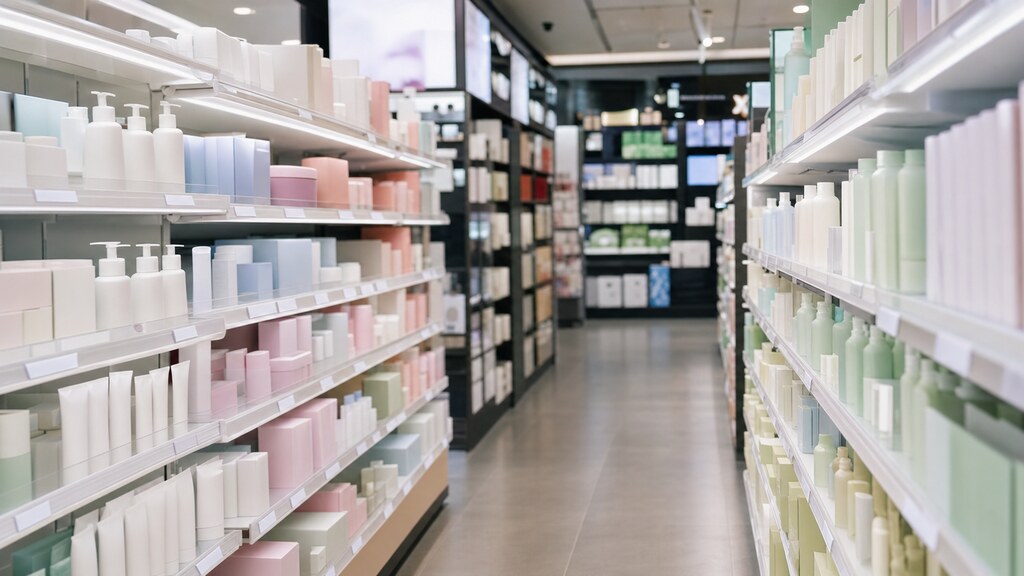
Multi-brand health-and-beauty chains — Olive Young being the dominant one — carry hundreds of Korean brands under one roof at mid-range prices. This is the default and there’s a reason for it.
Daiso, the variety chain where nothing costs more than ₩5,000, has quietly become a serious beauty destination in the last couple of years. Not as a joke, not as a last resort. Real cosmetics companies now manufacture for it.
Brand flagship stores are standalone shops for a single label — Innisfree, Etude House, Nature Republic, Missha, The Face Shop, Laneige and their neighbors — clustered thickest in Myeongdong. One brand, its full range, staff who know that one line properly.
Duty-free, both downtown and at the airport, is the one most visitors misunderstand. It’s excellent at exactly one job and mediocre at the job most people assume it does.
The useful mental model: these are not four price levels of the same store. They’re four different answers to four different needs. Daiso isn’t “cheap Olive Young,” and duty-free isn’t “Olive Young minus tax.” Once you see them as separate tools, the whole trip gets simpler to plan.
Olive Young: the default, and why
If you only do one beauty stop in Seoul, this is the one, and I’m going to keep this section short because I’ve already written the deep version.
The case for it is coverage. Full-size, name-brand products from a very large number of Korean labels, side by side, with bestseller tags and testers telling you what’s actually moving. Skincare items commonly land somewhere around ₩12,000–30,000, sales and 1+1 deals run near-constantly, big tourist-facing branches have English-speaking staff, and select branches process an immediate tax refund at the register with your passport. That combination — real products, one stop, refund handled on the spot — is why it’s the default recommendation and why my wife buys her actual routine there rather than anywhere else on this list.
What I won’t do here is repeat myself. Which branch to pick, exactly what’s worth putting in the basket, sample baskets by budget, and the step-by-step refund procedure all live in my Olive Young Seoul shopping guide. Read that one when you’re ready to shop. Read this one to decide whether that’s even where you should be going.
Daiso: the ₩5,000 ceiling that changed the game
This is the section I’d most want a visitor to read, because it’s the part of the landscape that has changed fastest and the part that sounds least believable.
Daiso’s entire model is a hard price ceiling. Nothing in the store costs more than ₩5,000, and the shelves are organized into tiers — ₩1,000, ₩2,000, ₩3,000, ₩5,000 — so you always know roughly what you’re holding before you check the tag. That’s been true for years. What’s new is what’s inside the beauty aisle.
Daiso Korea reported record sales of roughly ₩4.54 trillion in 2025, up about 14% on the year, and cosmetics have been a visible engine of that growth. The reason is that actual cosmetics companies started making Daiso-exclusive diffusion lines — pared-back products built to hit the ₩5,000 ceiling, sold only there. The partner list includes names people recognize: Jung Saem Mool, Too Cool for School, Tonymoly, Clio, VT and others have all put lines into those aisles. So the thing on the shelf is generally not anonymous filler from an unnamed factory. It’s a real brand’s formulation, stripped down and sized down to fit the price cap.
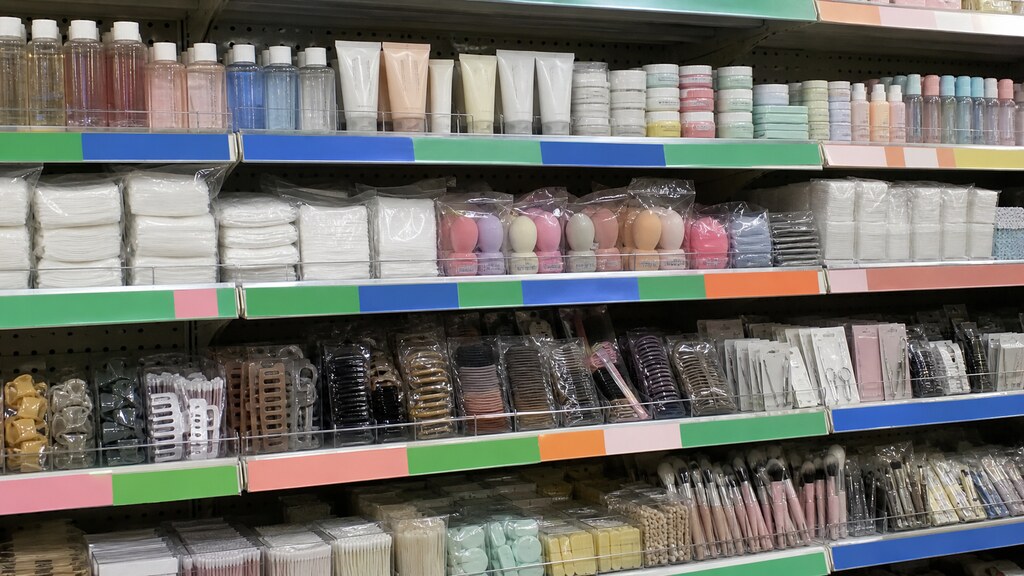
Now the reality check, because I’ve watched visitors get carried away in here. The ceiling has to come from somewhere, and it comes from size and ambition. Most of what you’re buying is a mini or trial format, or a basic: sheet masks, low-cost retinol and vitamin C serums, cotton pads, cleansing items, brushes, sponges, hair clips, small tools. These are genuinely fine products for what they cost. They are not full-size hero products, and if you’re expecting the 200ml bottle you saw on TikTok, it isn’t there.
So the honest verdict is that Daiso is outstanding for three specific jobs. First, cheap experimentation — trying a retinol or a new ingredient at ₩3,000 instead of ₩25,000 is a genuinely smart way to find out whether your skin tolerates it. Second, restocking basics you’ll burn through anyway. Third, and this is the one visitors underrate, volume gifting. If you have eleven coworkers to bring something back for, ₩5,000 each is the difference between a fun souvenir run and a painful one.
What Daiso isn’t: the place to build the routine you’ll still be using in six months. For that, go back to the previous section.
Brand flagship stores: when one brand is the point
Walk through Myeongdong and you’ll pass a dozen single-brand beauty stores in ten minutes — Innisfree, Etude House, Nature Republic, Missha, The Face Shop, Laneige and the rest, often within sight of each other. That density is the whole appeal, and it’s why the flagship route and a Myeongdong walking day fit together so neatly. If you’re planning that area anyway, my Myeongdong guide for first-time visitors covers the streets and the timing.
What a flagship gives you that a multi-brand chain can’t is depth in one line. Olive Young carries a brand’s bestsellers; the flagship carries the whole catalogue, including the shades, sizes and seasonal or limited items that never make it to a shared shelf. Testers are more plentiful and more organized. And the staff have been trained on one line rather than four hundred, so if you want to ask which of two moisturizers in the same family suits drier skin, you’ll get a real answer instead of a shrug toward the bestseller display.
On price, don’t expect a discount for going to the source. Flagship prices generally sit at or slightly above what the multi-brand chains charge for the same item, because the chains negotiate hard and promote constantly. Where flagships fight back is with generosity of a different kind — gift-with-purchase, sample sets, brand-membership perks and single-brand bundles that can be substantial. Whether that beats a 1+1 deal at Olive Young depends entirely on the week, and I’d treat both as moving targets.
Go to a flagship if you already love a brand, if you want a shade or size the chains don’t stock, or if you enjoy the browsing itself. Skip it if you’re comparison shopping across brands — you’ll walk a lot of pavement to do what one chain store does in one aisle.
Duty-free: when it actually wins (and when it doesn’t)
Duty-free is the most oversold option on this list for the specific thing most visitors want, and I’d rather say that plainly than be diplomatic.
The savings are real, but read what they apply to. Discounts are commonly quoted in the region of 15–40% against normal retail, and that spread is concentrated overwhelmingly in luxury and imported cosmetics, fragrance and alcohol. Those categories carry high margins and heavy taxes, so removing the tax layer moves the number a lot. Affordable Korean drugstore brands — the ₩15,000 sunscreen, the ₩12,000 cleanser — don’t have that structure to begin with. There’s much less tax to strip out, and the chains routinely run promotions that swallow whatever gap remains.
The second problem is catalogue. Duty-free shops carry a curated selection, not everything. Newer releases and the products currently trending in Korea are frequently missing, and there’s no browsing culture to speak of — you can’t wander a duty-free floor and discover what the country is actually buying right now. Downtown duty-free stores are larger than airport ones, but the same limitation applies.
So the honest split: buying a luxury cream, a designer fragrance, an imported name or spirits? Duty-free, comfortably, and it’s worth planning around. Buying everyday Korean skincare? The drugstore chains beat it on selection and usually on real-world price after promotions. I’ve seen visitors save their whole beauty budget for the airport and then find half their list unavailable at 6 a.m. with a boarding gate to catch. Don’t be that person.
What each place costs: the price tiers
Numbers make this concrete, so here’s the ladder from the bottom up. Everything below is a rough range that shifts with promotions, exchange rates and product, so treat it as a planning tool rather than a quote.
- Daiso: ₩5,000 and under. Hard ceiling, tiered at ₩1,000 / ₩2,000 / ₩3,000 / ₩5,000. Minis, trial sizes, basics, tools.
- Multi-brand chains: roughly ₩12,000–30,000 for a full-size skincare item, before the frequent sales and 1+1 deals that can cut the effective price meaningfully.
- Brand flagships: similar to slightly above the chains for the equivalent product, with gift-with-purchase and bundles doing the compensating.
- Department store counters and duty-free: premium tier, where imported and luxury lines live and where the 15–40% duty-free spread actually bites.
Seen as a ladder, the strategy writes itself. A gift run and a routine build are different budgets in different buildings. If you’re mapping total trip spending, I put the broader picture — cards, cash, what things cost day to day — in the Seoul money and budget guide.
Which categories are worth the trip in 2026
Briefly, because this is a venue guide and not a product review, and I’m not the person to be reviewing serums.
The market’s center of gravity has moved toward “slow aging” and barrier repair — gentler, longer-horizon products — and away from the aggressive-actives phase of a few years ago. Sunscreen remains the category international shoppers rate most consistently, and it’s the one I’d point at first if someone wanted a single justification for shopping here at all. Sheet masks are the volume buy, sold in 1+1-style deals everywhere. Lip tints and cushion makeup are still the strongest makeup exports.
Map those to venues and it’s clean enough: sunscreen and anything you’ll use daily belong at the chains, where the full-size selection is. Sheet masks work at either the chains on deal or at Daiso by the armful. Shade-dependent makeup — cushion especially — argues for a flagship where the testers are.
Matching the venue to what you want
Four questions, four answers.
Short trip, want the routine that actually works? Olive Young or another multi-brand chain, one visit, done. You’ll see what’s popular, get full sizes, and handle the refund in the same building.
Tight budget, or buying for a long list of people? Daiso, and don’t feel bad about it. Real brands, capped prices, and a gift run that doesn’t wreck your trip budget.
Committed to one brand, or want to test properly before buying? The Myeongdong flagship cluster. Full range, best testers, staff who know the line.
Buying luxury, imported names or perfume? Duty-free, and buy it there rather than in town.
Two more factors before you go. Tax refund is a genuine tiebreaker for the chains: large tourist-facing branches commonly process an immediate refund at the register with your passport, roughly 5–8% back, applied per receipt within a set purchase range. Long-stay residents — six months or more in Korea — generally don’t qualify. I’m not repeating the mechanics here; the in-store version is in the Olive Young guide and the departure-day version, kiosk by kiosk, is in my Incheon Airport tax refund guide.
And logistics, which people ignore until the check-in counter. Beauty products are liquids and they are heavy. A hundred sheet masks and six full-size bottles will show up on the scale and in your carry-on screening, so keep the volume rules in mind and put the big bottles in checked luggage. The simplest fix is timing: shop late in the trip. Nobody has ever been glad they carried three kilos of skincare around Seoul for nine days.
One last thing
The mistake I see isn’t buying the wrong product. It’s buying the right product in the wrong building — the ₩3,000 experiment paid for at ₩25,000, or the full-size routine attempted at a store where everything comes in 15ml. Pick the venue first and the rest gets much less stressful.
If your trip’s still taking shape, the first-time-in-Seoul hub is where I’d start, then slot the beauty stop in near the end. And if you do go to Daiso, budget more time than you think. Everyone says they’ll be twenty minutes.
— Bo
FAQ
Where is the cheapest place to buy K-beauty in Seoul? Daiso, without much competition. Everything is capped at ₩5,000 with tiers at ₩1,000, ₩2,000, ₩3,000 and ₩5,000. The trade-off is that most beauty items there are mini or trial sizes and basics rather than full-size products.
Is Daiso beauty in Korea any good? Better than the price suggests. Established cosmetics companies — Jung Saem Mool, Too Cool for School, Tonymoly, Clio and VT among them — produce Daiso-exclusive lines, so it isn’t unbranded product. It works well for testing an ingredient cheaply, restocking basics, and buying gifts in volume.
Is duty-free cheaper than Olive Young for Korean skincare? Usually not. Duty-free savings of roughly 15–40% concentrate on luxury and imported cosmetics, perfume and alcohol. For affordable Korean drugstore brands the chains generally win on selection and on real price after their frequent promotions, and duty-free catalogues often skip newer releases.
Where do locals buy skincare in Seoul? Mostly at multi-brand chains like Olive Young for the products they actually use, with Daiso increasingly picking up basics, tools and cheap trials. Flagship stores get visited for a specific brand, and duty-free is treated as a luxury and perfume stop rather than a routine one.
Planning your first Seoul trip? Start at the first-time-in-Seoul hub, or send a question through the Contact page.